
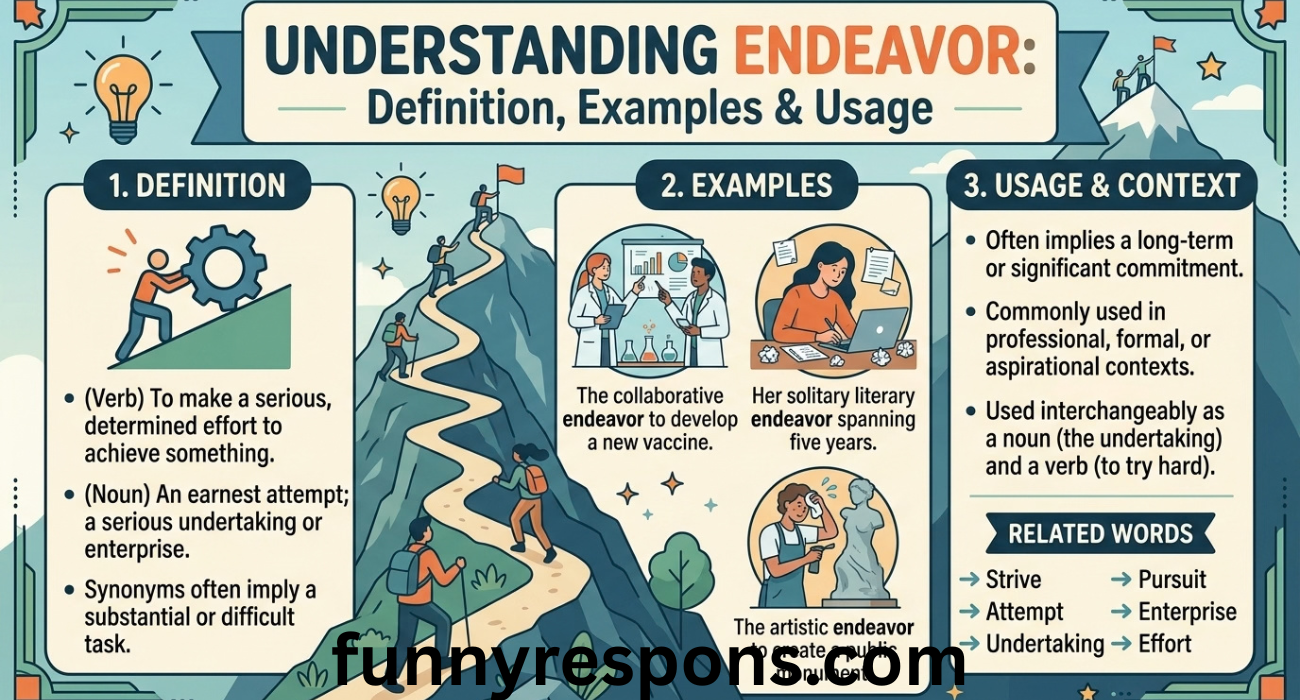
Endeavor Meaning | Definition, Examples, and Usage
If you’re searching for Endeavor Meaning, the word generally refers to a serious effort or attempt to do something. In American English, endeavor can work as both a noun and a verb. As a noun, it describes an effort, attempt, or undertaking. As a verb, it means to try, especially with determination.
For example, “Starting a business is a major endeavor” means starting a business is a major undertaking that requires effort. “We will endeavor to help” means “We will try to help.” The word often sounds more formal than everyday words such as “try” or “attempt.”
The spelling endeavor is standard in American English, while endeavour is the usual British spelling. The meaning remains the same. This guide explains the Endeavor Meaning in Text, chat, social media, school, and workplace communication, along with examples and natural ways to reply.
What Does Endeavor Mean?

Endeavor means a serious effort or attempt to accomplish something. It can describe the effort itself or the activity that requires that effort. Cambridge defines the noun as an effort or attempt and the verb as “to try to do something.”
As a noun, endeavor refers to an effort, undertaking, pursuit, or challenging project:
- “Writing a book is a long-term endeavor.”
- “Her research endeavor required patience.”
- “The team began a new business endeavor.”
As a verb, endeavor means to try to do something, often with determination:
- “We will endeavor to solve the problem.”
- “He endeavored to meet the deadline.”
- “She will endeavor to improve her results.”
The word does not have a hidden slang meaning. Its basic meaning stays connected to effort, attempt, and trying to achieve a goal.
Read Also : Other Ways to Say Have a Good Day: 40 Friendly and Natural Alternatives
Endeavor Meaning in Detail
The Endeavor Meaning becomes clearer when you look at its two grammatical uses.
Endeavor as a noun: It means an effort, attempt, undertaking, or pursuit. It often describes something that takes time, commitment, persistence, or skill.
Endeavor as a verb: It means to make a serious attempt or try to do something. The verb commonly appears in the structure endeavor to + verb, such as “endeavor to improve” or “endeavor to provide.”
The word can describe a successful or unsuccessful attempt. Saying that something was an endeavor does not guarantee a positive result. It focuses more on the effort or undertaking than on whether the person succeeded.
Is Endeavor a Formal Word?
Yes. Endeavor is a standard English word, and it often has a formal or polished tone. Major learner dictionaries identify the noun and verb as formal, particularly in uses such as “endeavor to do something.”
You may see it in professional writing, academic writing, business communication, official statements, and formal conversation. For example, “We will endeavor to resolve the matter promptly” sounds more formal than “We’ll try to fix it soon.”
That doesn’t make endeavor incorrect in casual conversation. It simply sounds more deliberate and formal than “try.” In a friendly text, “I’ll try” usually feels more natural.
Is Endeavor Slang?
No. Endeavor is not slang. It is a standard English word with established noun and verb uses. Dictionaries list it as the American spelling of endeavour, not as texting slang or internet slang.
So, if someone uses “endeavor” in a text message, chat, TikTok caption, Instagram post, or Snapchat message, you should normally understand it according to its regular dictionary meaning.
A social-media user might use the word humorously or playfully, but that comes from the surrounding context. The word itself does not become slang simply because someone uses it online.
How Context Changes the Meaning
The basic meaning stays the same, but the context can change what kind of effort or undertaking the speaker has in mind.
1. A personal goal
An endeavor can describe a personal goal that requires meaningful effort and persistence.
Example:
“Learning Spanish has become a rewarding endeavor for me.”
Here, “endeavor” describes the person’s serious attempt to learn the language. It suggests commitment rather than a quick, casual try.
2. A professional task
In the workplace, endeavor can refer to a professional task, business goal, or organized effort.
Example:
“Our team will endeavor to complete the project by Friday.”
The sentence has a professional tone. It means the team will make a determined effort to meet the deadline.
3. A difficult project
The word often fits a challenging project that requires substantial time or energy.
Example:
“Building the community center was a major endeavor.”
Here, “endeavor” means a large undertaking. The sentence emphasizes the scale and effort involved.
4. A playful conversation
People can also use formal words in a playful way.
Example:
Friend A: “Are you really going to bake a three-tier cake tonight?”
Friend B: “Yes. I shall endeavor to survive the kitchen.”
The speaker is being humorous. The formal wording creates the joke. Endeavor itself still has its normal meaning.
Endeavor in Text and Chat
The Endeavor Meaning in Text is usually the same as its regular English meaning. If someone writes, “I’ll endeavor to finish it tonight,” they mean, “I’ll try to finish it tonight.”
However, the word can sound more formal than most everyday texting language. Friends might normally say:
- “I’ll try.”
- “I’ll do my best.”
- “I’ll give it a shot.”
- “I’ll work on it.”
By comparison, “I’ll endeavor to finish it” has a polished or professional tone.
If someone sends “I’ll endeavor to help”, don’t assume they are being sarcastic or distant. The context matters. They may simply prefer formal language.
The same applies to the Endeavor Meaning in Chat. It normally means an effort or attempt, not a special texting code.
Endeavor on Social Media
The Endeavor Meaning on Social Media remains the ordinary meaning of the word. A person might use it in a caption about a career goal, creative project, education, fitness challenge, or another personal pursuit.
For example:
“Starting my own company is a challenging but exciting endeavor.”
Here, “endeavor” means a major undertaking.
On TikTok, Instagram, Snapchat, or another platform, users may also use formal words for humor. Someone might caption a simple task with “Today’s endeavor” to make an ordinary activity sound unusually serious.
That playful use comes from the context and tone, not from a new slang definition. There is no standard “Endeavor Meaning on TikTok” or separate “Endeavor Slang Meaning” that replaces the dictionary meaning.
Real Conversation Examples
1: Workplace
Person A: “Can you finish the report by tomorrow?”
Person B: “I’ll endeavor to have it ready by noon.”
Meaning: Person B will make a serious effort to finish the report by noon.
This wording fits business communication because it has a professional tone.
2: Friends
Person A: “Are you coming to the game tonight?”
Person B: “I shall endeavor to arrive before kickoff.”
Meaning: Person B is saying they will try to arrive before the game starts.
Among friends, the wording may sound intentionally formal or funny. A simpler reply would be, “I’ll try to get there before kickoff.”
3: Academic conversation
Student A: “Are you planning to finish your research paper this weekend?”
Student B: “Yes. I’ll endeavor to complete the first draft by Sunday.”
Meaning: The student intends to make a determined effort to finish the draft.
This use works naturally in an academic conversation because the word has a formal, polished tone.
What Tone Does Endeavor Have?
Endeavor usually has a formal, serious, and professional tone. It can make a sentence sound more polished than the simpler word “try.”
Compare these examples:
- Casual: “I’ll try to finish it.”
- Neutral: “I’ll make an effort to finish it.”
- Formal: “I’ll endeavor to finish it.”
All three express a similar intention. The difference mainly comes from tone and wording.
As a noun, “endeavor” can also make an activity sound substantial:
- “a business endeavor”
- “a scientific endeavor”
- “a creative endeavor”
- “a personal endeavor”
The word does not automatically suggest success. It describes the effort, attempt, or undertaking.
Is Endeavor Rude?
No. Endeavor is not inherently rude, insulting, or offensive. Its meaning is neutral, although its formal tone may feel unusual in a very casual conversation.
For example, “I will endeavor to help” is generally a polite statement of intention. It does not contain an insult or negative message.
Still, context matters. If someone uses extremely formal language with close friends, they may be joking. For example, “I shall endeavor to locate your missing sock” could sound funny because the language is much more formal than the situation requires.
The tone comes from the whole message, not from the word endeavor alone.
How to Reply to Endeavor
Your reply should match the situation and the speaker’s tone. If the conversation is professional, a neutral or polite response usually works well. With friends, you can be more relaxed or humorous.
Friendly Replies
If someone says, “I’ll endeavor to make it tonight,” you can respond naturally:
- “Sounds good!”
- “No worries. Do your best.”
- “Hope you can make it!”
- “That works for me.”
- “Great, see you later.”
These friendly replies keep the conversation relaxed without overthinking the formal wording.
Funny Replies
If a friend uses endeavor in an obviously formal way, you can play along:
- “Very noble of you.”
- “I respect the endeavor.”
- “May your endeavor succeed!”
- “A brave endeavor indeed.”
- “Good luck with this important mission!”
These replies work best when the conversation already has a playful tone.
Polite Replies
For professional or formal communication, you could say:
- “Thank you. I appreciate your effort.”
- “That sounds good. Thank you.”
- “I appreciate your willingness to help.”
- “Thank you for making the effort.”
- “I look forward to the result.”
Choose a reply that matches the relationship and situation rather than focusing only on the word itself.
When to Use the Word Endeavor
Use endeavor when you want to describe a meaningful effort, serious attempt, or substantial undertaking.
It works especially well in:
- Professional writing
- Academic writing
- Business communication
- Formal correspondence
- Reports and presentations
- Discussions about challenging projects
- Descriptions of long-term goals
For example:
“The organization launched a new environmental endeavor.”
“She made every endeavor to improve the program.”
“The research was a difficult but worthwhile endeavor.”
The verb also works well when you want a formal alternative to “try”:
“We will endeavor to provide an answer soon.”
Oxford specifically gives formal examples using endeavor to do something, while Cambridge identifies the verb as meaning to try to do something.
When to Avoid Endeavor
You don’t need to avoid endeavor because it is incorrect. Instead, consider whether its formal tone fits the conversation.
In casual texting, everyday words usually sound more natural:
- “I’ll try.”
- “I’ll do my best.”
- “I’ll work on it.”
- “I’ll give it a shot.”
For example, texting a close friend “I will endeavor to arrive at 7” can sound overly formal if you normally say, “I’ll try to be there at 7.”
That doesn’t make the formal version wrong. It simply creates a different tone.
Common Mistakes With Endeavor

One common mistake is treating endeavor as slang. It isn’t. It is a standard English word used as both a noun and a verb.
Another mistake is assuming that endeavor means guaranteed success. It does not. An endeavor can succeed or fail because the word describes the effort or attempt.
Incorrect idea: “Endeavor means you succeeded.”
Better understanding: “Endeavor means you made an effort or attempted something.”
A third mistake involves grammar. When endeavor works as a verb, it commonly takes to + verb:
- “We endeavor to improve.”
- “She endeavored to help.”
- “They will endeavor to finish.”
As a noun, it can describe an activity or undertaking:
- “The project was a major endeavor.”
- “Her artistic endeavors continued for years.”
Also remember the spelling difference: endeavor is the American English spelling, while endeavour is used in British English.
Read Also : Coach’s vs Coaches’ vs Coaches: What’s the Real Difference?
Similar Words to Endeavor
Several words have meanings close to endeavor, but their tone and usage can differ.
| Word | Common meaning | Typical tone |
|---|---|---|
| Try | Make an attempt | Casual and neutral |
| Attempt | Try to do something | Neutral |
| Effort | Energy used to achieve something | Neutral |
| Strive | Work hard toward a goal | Formal or neutral |
| Undertaking | A task or project | Formal |
| Pursuit | Activity directed toward a goal | Neutral or formal |
| Aspire | Have a strong goal or ambition | Neutral or formal |
Cambridge lists try, attempt, make an effort, strive, undertake, and do one’s best among related words for endeavor.
The best synonym depends on your sentence. “Try” often sounds natural in casual conversation, while “endeavor” can suit professional or polished writing.
Origin and Usage
The word endeavor has a long history in English. Oxford traces it to late Middle English and connects its earlier sense with the idea of exerting oneself or doing one’s utmost.
Modern English uses endeavor as both a noun and a verb. In American English, endeavor is the standard spelling. British English commonly uses endeavour.
Its modern uses remain closely connected to effort and attempting something. You might encounter it in professional documents, academic contexts, formal writing, and descriptions of important personal or collective projects.
It can also appear in everyday language, although simpler alternatives such as “try” often sound more natural in relaxed conversation.
Endeavor Meaning in American English
In American English, endeavor means a serious effort, attempt, or undertaking. It can describe a personal goal, professional task, or challenging project. The spelling “endeavor” is standard in the United States, while “endeavour” is commonly used in British English. Both forms have the same basic meaning and can function as a noun or verb.
For example, “Starting a new career is a major endeavor” describes a significant undertaking. As a verb, “She will endeavor to improve” means she will make a determined effort. The word often sounds more formal than “try,” so it appears frequently in professional communication, academic writing, and polished English.
Endeavor Meaning and Usage in a Sentence
Understanding endeavor meaning becomes easier when you see how the word works in real sentences. As a noun, it can describe an effort or undertaking, such as “The project was a difficult endeavor.” Here, the word highlights the work and commitment required to complete the project. The sentence has a neutral yet formal tone.
As a verb, endeavor usually appears before an infinitive: “We will endeavor to meet your request.” This means “We will try to meet your request.” The verb often communicates intention and effort without promising a specific result. That makes it useful when careful, professional wording matters.
Endeavor vs Attempt: What Is the Difference?
Endeavor and attempt can both describe an effort to do something, but they can create slightly different impressions. “Attempt” often focuses on the act of trying, while “endeavor” can suggest a sustained or meaningful effort. For example, “He attempted to repair the car” simply describes a try. “Repairing the old car was a major endeavor” emphasizes the larger undertaking.
The difference becomes clearer through tone. “Attempt” works naturally in everyday and professional English. Endeavor tends to sound more formal or polished. Neither word automatically means success. Both can describe an effort that produces the desired result or one that does not.
Endeavor Meaning in Professional Communication
In professional communication, endeavor can express a serious intention without making an absolute promise. A company might say, “We will endeavor to respond within two business days.” This communicates that the company intends to make a serious effort. The wording sounds more formal than “We will try to respond soon.”
The word can also describe major workplace projects or initiatives. For example, “The expansion was a significant business endeavor” identifies the expansion as a substantial undertaking. Because endeavor has a professional tone, it can fit reports, formal emails, presentations, and workplace documents when a polished style is appropriate.
Quick Recap
The Endeavor Meaning is simple: it refers to a serious effort, attempt, or undertaking. As a noun, it can mean an effort or project. As a verb, it means to try to accomplish something.
Endeavor is not slang. It is a standard English word with a formal or polished tone. In American English, “endeavor” is the usual spelling, while British English commonly uses “endeavour.”
In text, chat, TikTok, Instagram, Snapchat, or workplace communication, the meaning normally depends on the surrounding sentence. If someone says, “I’ll endeavor to help,” they mean they will try to help. If someone calls a project “a major endeavor,” they mean it is a substantial undertaking.
Understanding the tone helps you choose the right response. Use “try” for casual conversation and “endeavor” when a more formal, professional, or polished tone fits.
FAQs
What Is the Real Meaning of Endeavor?
Endeavor means a serious effort, attempt, or undertaking. It can describe something you work hard to accomplish or an important project you take on.
What Is the Synonym of Endeavour?
Common synonyms for endeavor include effort, attempt, try, pursuit, undertaking, and strive. The best choice depends on the sentence and tone.
What Does Future Endeavors Mean?
“Future endeavors” means the efforts, goals, projects, or activities someone plans to pursue in the future. It often appears in professional good wishes.
How Can I Use Endeavor?
Use endeavor as a noun for an important effort or project, or as a verb meaning “to try.” For example, “She will endeavor to improve her skills.”
Conclusion
The Endeavor Meaning is a serious effort, attempt, or undertaking. As a noun, endeavor can describe a project or pursuit. As a verb, it means to try to accomplish something. The word sounds formal and polished, so it fits professional writing. In American English, endeavor is the usual spelling, while British English uses endeavour. Its meaning focuses on effort.
In text, chat, or social media, endeavor usually keeps its standard meaning rather than becoming slang. Context helps you understand the tone. Use it to describe meaningful effort or a substantial task. For casual messages, “try” may sound more natural. For formal communication, endeavor can express a serious attempt professionally. Choose wording that matches your situation and your audience.