Other Ways to Say As Soon As Possible: 40 Polite and Professional Alternatives
Other Ways to Say As Soon As Possible are different phrases that ask for quick action.
They help you sound clear, polite, and professional in different situations.
You can choose a phrase based on the urgency and the person you address.
The right words can change how your message sounds.
A small phrase can make a request feel polite and friendly.
It can also show that a task needs quick attention.
These alternatives work well in emails, school notes, and work messages.
Some phrases sound formal, while others sound simple and friendly.
Using the right phrase helps you communicate your message clearly.
Polite & Effective Alternatives to “As Soon As Possible”
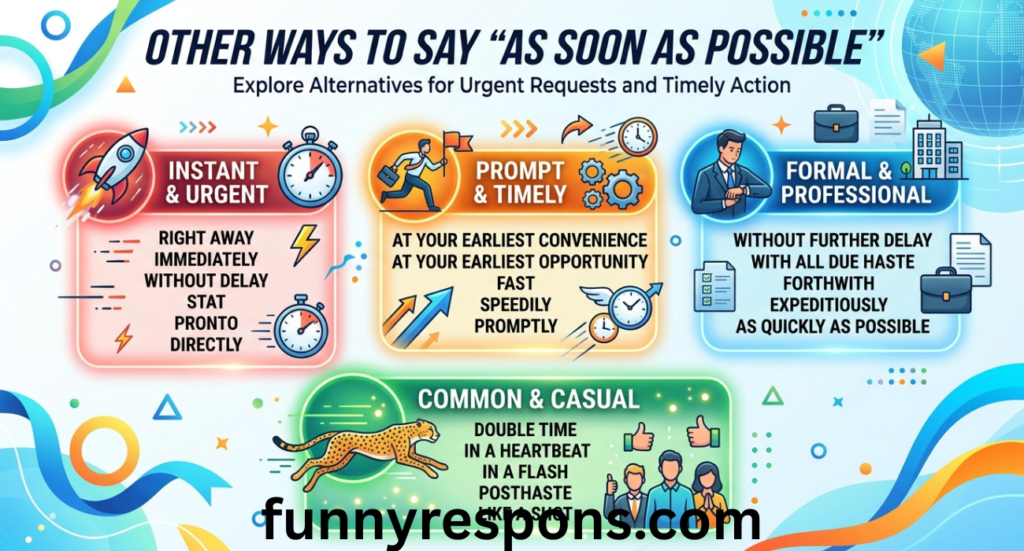
The best alternative depends on the relationship, urgency, and setting. A request to a close teammate can sound relaxed, while a message to a customer or executive may need more polished wording. The expressions below give you options ranging from gentle requests to firm instructions.
A useful rule is simple: the more urgent the task, the more direct your wording should become. For routine work, flexibility sounds considerate. For a deadline-driven task, clarity matters more than elegance. If you know the exact deadline, include it. “Please send the contract by 3 p.m. today” leaves much less room for confusion than “Please send the contract ASAP.”
Read Also Coach’s vs Coaches’ vs Coaches: What’s the Real Difference?
1. At your earliest convenience
At your earliest convenience is one of the most common formal alternatives to “as soon as possible.” It means that you want something done as soon as the other person reasonably can. Cambridge defines the phrase as doing something “as soon as you like or can,” which makes it suitable for polite requests.
Use it when you need action soon but don’t want to sound demanding. It works particularly well in business emails, customer communication, and formal requests. For example: “Please send the signed agreement at your earliest convenience.”
However, don’t use it when you actually need an immediate response. The phrase leaves the exact timing open. If the deadline matters, add one. “Please send the signed agreement at your earliest convenience, preferably by Thursday” gives the reader a much clearer target.
2. As soon as you can
As soon as you can sounds natural, warm, and conversational. It asks someone to act quickly while recognizing that they may already have other responsibilities.
This expression works well with coworkers, friends, clients you know well, and people you communicate with regularly. For example, “Please send me the revised draft as soon as you can.”
Compared with “immediately,” this wording feels less forceful. It says the task matters without suggesting that the recipient should drop everything else. That makes it one of the most useful everyday alternatives to ASAP.
3. When you have a moment
When you have a moment is a gentle way to request someone’s attention. It works best when the task matters but doesn’t require emergency treatment.
Imagine sending a quick message to a coworker: “Could you review this proposal when you have a moment?” The wording feels considerate because it acknowledges that the person may be busy.
Don’t use this phrase when a strict deadline is approaching. The recipient may reasonably assume that the request can wait. For urgent work, choose something more direct.
4. At your earliest opportunity
At your earliest opportunity has a formal, professional tone and communicates that you want action soon. It fits business correspondence, workplace requests, and other situations where you want to sound courteous without becoming overly casual.
For example: “Please contact the accounting department at your earliest opportunity.”
The phrase also works well when the recipient controls the timing. It encourages prompt action without giving a specific deadline. If timing is critical, however, provide the actual due date instead.
5. Promptly
Promptly is short, direct, and professional. It tells the reader that you expect quick action without repeating the longer phrase “as soon as possible.”
For example: “Please respond promptly so we can finalize the schedule.”
The word can sound firmer than some of the softer alternatives. In certain contexts, it may even imply that the recipient has already been slow to respond. Grammarly similarly points out that “promptly” can sometimes carry a slightly pointed tone. Use it when speed genuinely matters.
6. Without delay
When a task cannot reasonably wait, without delay makes that expectation clear. It has a serious tone and works best for time-sensitive requests.
For example: “Please notify the customer without delay if the shipment changes.”
This expression sounds stronger than “when you have a moment.” It can work well in formal workplace communication, operational instructions, and situations involving a meaningful deadline. Avoid it for minor requests because it can make a small task sound like a crisis.
7. As quickly as you’re able
As quickly as you’re able combines urgency with understanding. Instead of demanding immediate action, it recognizes that the recipient may have limits on their time or resources.
For example: “Please review the updated proposal as quickly as you’re able.”
This wording is especially helpful when you’re working collaboratively. It tells someone that speed matters while still giving them reasonable room to manage their workload.
8. When you get a chance
For casual workplace communication, when you get a chance offers a relaxed alternative to ASAP. It suggests that you want the task completed but don’t want to create pressure.
You might write, “Could you look over the presentation when you get a chance?”
This phrase is a poor choice for a true deadline. If you need the presentation before tomorrow’s client meeting, say so. Otherwise, “when you get a chance” may signal that the task can wait indefinitely.
9. In a timely manner
In a timely manner has a formal business tone. Companies often use it when discussing responses, deliveries, service requests, or administrative tasks.
For example: “Please complete the required paperwork in a timely manner.”
Its biggest advantage is professionalism. Its biggest weakness is vagueness. The reader still may not know whether you mean today or next week. When possible, replace general timing with a clear deadline.
10. As soon as practical
As soon as practical works when you want something handled quickly but understand that practical constraints exist.
For example: “Please update the inventory records as soon as practical.”
This phrase can be useful when a task depends on other work, technical conditions, staffing, or available resources. It avoids promising an unrealistic turnaround while still establishing that the task shouldn’t sit unattended.
11. As soon as it’s feasible
As soon as it’s feasible has a similar meaning but places more emphasis on whether the action is realistically possible.
For example: “Please schedule the installation as soon as it’s feasible.”
Use this wording when circumstances may affect timing. It sounds thoughtful rather than demanding because it recognizes that speed isn’t always the only factor.
12. Swiftly
Swiftly provides a concise alternative when you want to emphasize fast action. It sounds polished and somewhat formal.
For example: “The team responded swiftly to the customer complaint.”
You can also use it in a request: “Please address the issue swiftly.” Because the word is strong, it works best when quick action genuinely matters.
13. At your soonest availability
At your soonest availability focuses on the other person’s schedule. It works particularly well for meetings, phone calls, interviews, and requests for a response.
For example: “Please let me know your availability at your soonest availability” is awkward because of repetition. A better sentence is: “Please let me know when you’re available at your soonest opportunity.”
For scheduling, even clearer wording is often better: “Could you let me know whether you’re available tomorrow morning?” Specific questions reduce back-and-forth and make the next step obvious.
14. With urgency
With urgency clearly signals that a matter deserves serious attention. It works when you need the reader to treat a request as a priority.
For example: “Please review the security notice with urgency.”
This phrase has an assertive tone, so use it selectively. If every request carries “urgency,” the word loses its impact. Reserve it for genuinely important matters.
15. At the earliest moment
At the earliest moment is a formal way to request quick action. It emphasizes speed while retaining a courteous tone.
For example: “Please contact me at the earliest moment you’re available.”
The phrase fits formal writing better than casual conversation. In everyday messages, “as soon as you can” usually sounds more natural.
16. When possible
When possible gives the recipient flexibility. It works particularly well for routine requests where you want action but don’t have a strict deadline.
For example: “Please send the updated file when possible.”
This phrase can sound too relaxed if the task is actually urgent. If you need the file before a meeting, give the reader a deadline instead of leaving the timing open.
17. At once
At once means immediately. It has a firm tone and can sound commanding, especially in workplace communication.
For example: “Please stop the process at once if you notice a safety issue.”
Because it carries considerable urgency, save it for situations where immediate action truly matters. For everyday requests, “right away” or “as soon as you can” may feel more natural.
18. Right away
Right away is the conversational cousin of “at once.” It clearly means immediately but usually sounds friendlier.
For example: “I’ll send the revised document right away.”
It works well in emails, chats, texts, and spoken conversations. If you’re writing a formal legal or corporate document, another phrase may fit better.
19. In short order
In short order means relatively quickly or without taking much time. It has a polished, traditional feel.
For example: “We expect to resolve the issue in short order.”
This phrase can add variety to professional writing, especially when you don’t want to repeat “quickly.” It doesn’t necessarily mean “this second,” so don’t use it when immediate action is required.
20. Quickly
Quickly is simple, familiar, and easy to understand. Sometimes the plainest word is the strongest choice.
For example: “Please review the document quickly so we can submit it today.”
You can soften it with “please,” “could you,” or a reason. Compare “Review this quickly” with “Could you review this quickly so we can submit the application today?” The second version sounds more cooperative because it explains why speed matters.
21. With all due speed
With all due speed is formal and somewhat old-fashioned. It emphasizes that something should happen as quickly as circumstances reasonably allow.
For example: “Please process the documents with all due speed.”
This expression can work in highly formal writing, but it may sound unusual in a normal American workplace email. In most modern communication, “promptly,” “quickly,” or a specific deadline will sound more natural.
22. Immediately
Immediately leaves little doubt about urgency. It tells the reader that the task should happen now or with virtually no delay.
For example: “Please contact the manager immediately if the system goes offline.”
Use this word carefully. If you say “immediately” when you really mean “sometime today,” you create unnecessary pressure. Save it for emergencies, critical deadlines, or situations where waiting could cause harm or serious disruption.
23. When time allows
When time allows is one of the gentlest alternatives to “as soon as possible.” It tells the reader that the request matters but can fit around their existing priorities.
For example: “Please review the archived files when time allows.”
This wording works for low-priority tasks. It should not appear in a message about a deadline unless you also provide a clear due date.
24. As a priority
As a priority asks the reader to move the task higher on their list. It doesn’t necessarily mean “right now,” but it does indicate that the task deserves prompt attention.
For example: “Please handle the customer complaint as a priority.”
This phrase works particularly well in professional environments because it focuses on importance rather than simply demanding speed. If the task must be finished by a particular time, state that time too.
25. As soon as it works for you
As soon as it works for you combines urgency and flexibility. It tells the recipient that you’d like quick action while respecting their schedule.
For example: “Please call me back as soon as it works for you.”
This expression works nicely for scheduling conversations, meetings, and personal follow-ups. It sounds accommodating and avoids the pressure that “immediately” can create.
26. As Soon As Possible: A Clear and Direct Alternative

As soon as possible remains one of the clearest ways to request quick action. It is widely understood in workplace emails, messages, and everyday conversations. However, the phrase does not establish an exact deadline, so readers may interpret urgency differently. When timing matters, pair it with a specific date, time, or expected response window to make your request clearer today.
Use this phrase when you need flexibility but still want to communicate urgency. For example, “Please send the updated report as soon as possible.” sounds direct and familiar. If the task is genuinely urgent, explain why and provide a deadline. That approach reduces confusion, helps recipients prioritize correctly, and creates a more useful request for everyone involved today at work.
27. At the Earliest Possible Time: A Formal Alternative
At the earliest possible time is a formal alternative to “as soon as possible” that clearly signals urgency. It can fit business emails, workplace instructions, formal requests, and professional notices. The wording emphasizes speed while maintaining a measured tone. Because it sounds somewhat formal, it works best when you want your request to appear serious, deliberate, and professionally appropriate today.
For example, “Please contact the client at the earliest possible time” communicates that the call should not be unnecessarily delayed. This phrase is useful when immediate action matters, but you do not need to demand that someone stop everything instantly. In casual messages, a simpler expression such as “as soon as you can” may sound more natural and conversational today.
28. As Soon As Humanly Possible: A Strong Urgent Alternative
As soon as humanly possible strongly emphasizes urgency and suggests that you want something completed with maximum speed. It can be effective when a genuine problem requires immediate attention, especially in informal workplace communication. However, the phrase can sound dramatic or emotional in highly formal settings. Consider your relationship with the reader before using such strong language carefully in writing.
For example, “Please restore access as soon as humanly possible” communicates that the situation feels pressing. Use this wording when delays could create serious inconvenience or disruption. If the request is routine, choose a calmer alternative instead. Overusing intense expressions can weaken their impact and make ordinary tasks appear more urgent than they actually are to the recipient today.
29. At Your Earliest Possible Time: A Polite Alternative
At your earliest possible time is a courteous alternative that places attention on the recipient’s schedule. It asks someone to act promptly while recognizing that they may have existing commitments. The phrase can work in professional emails, client communication, and workplace requests. Its respectful tone makes it useful when you want urgency without sounding overly demanding, impatient, or forceful.
For example, “Please review the proposal at your earliest possible time” gives the reader flexibility while encouraging prompt attention. Still, the wording can feel slightly formal or awkward in casual conversation. If you know when you need the task completed, a specific deadline is usually clearer. Otherwise, this expression offers a polite middle ground between flexibility and urgency for most requests.
30. As Soon As Circumstances Permit: A Professional Alternative
As soon as circumstances permit is a formal expression that recognizes outside factors may affect timing. It asks someone to act promptly when conditions allow, rather than demanding immediate completion regardless of obstacles. This makes it useful for business communication, official notices, workplace instructions, and situations involving approvals, availability, logistics, or other practical constraints that could reasonably delay action today.
For example, “Please provide the requested documents as soon as circumstances permit” sounds firm but understanding. The phrase works especially well when you cannot control every factor affecting completion. It also avoids implying that someone should ignore important limitations. For everyday emails, however, simpler wording may feel more natural. Choose it when circumstances genuinely influence when the requested action can happen.
31. At the First Opportunity: A Natural Alternative to ASAP
At the first opportunity is a concise way to request action at the next suitable chance. It communicates that something should receive attention promptly without necessarily requiring immediate action. This phrase works well in professional emails, workplace conversations, and formal requests. Its balanced tone makes it useful when you want to express urgency while still allowing the reader reasonable flexibility today.
For example, “Please call me at the first opportunity” signals that the conversation matters and should happen soon. It does not force the recipient to respond instantly. This makes the expression helpful for tasks that need prompt attention but are not emergencies. In casual settings, “when you get a chance” may sound warmer, simpler, and more conversational for most readers.
32. At the Earliest Possible Opportunity: A Formal ASAP Alternative
At the earliest possible opportunity is a formal alternative that asks someone to act at the first reasonable chance. It conveys urgency while acknowledging that immediate action may not always be practical. The phrase fits business correspondence, official communication, workplace requests, and professional instructions. Its polished tone can make an important request sound deliberate rather than abrupt or demanding today.
For example, “Please review the attached agreement at the earliest possible opportunity” encourages prompt attention without setting a fixed deadline. Because the wording is long, it can feel heavier than necessary in everyday messages. When clarity and brevity matter, a simpler phrase may work better. Use this option when formality, urgency, and flexibility all need to appear together naturally today.
33. As Soon As Reasonably Possible: A Balanced Alternative
As soon as reasonably possible is a useful alternative when you want to request prompt action while recognizing practical limits. The word “reasonably” softens the urgency and acknowledges that people may face workload, resources, scheduling, or other constraints. This makes the expression particularly suitable for professional communication where you want cooperation without creating an unrealistic expectation about immediate completion or response.
For example, “Please complete the revisions as soon as reasonably possible” encourages progress while allowing the recipient to manage existing priorities. It is stronger than “when you have time,” but less forceful than “immediately.” This balance makes it useful for workplace requests, project updates, and client communication. When timing is critical, add a specific deadline to remove uncertainty completely today.
34. As Soon As You Are Able: A Polite ASAP Alternative
As soon as you are able is a polite way to request quick action without creating unnecessary pressure. It recognizes that the reader may have other responsibilities while still showing that the task deserves attention. This phrase works well in professional emails, workplace conversations, and personal messages. Its flexible tone makes it respectful, practical, and easy to understand for most readers.
For example, “Please send the revised document as soon as you are able” encourages prompt action while giving the recipient reasonable flexibility. Use it when urgency matters, but you do not need an instant response. If the task must be finished by a particular time, include a clear deadline. That combination makes expectations easier to understand and follow today.
35. At the Earliest Possible Opportunity: A Professional Alternative
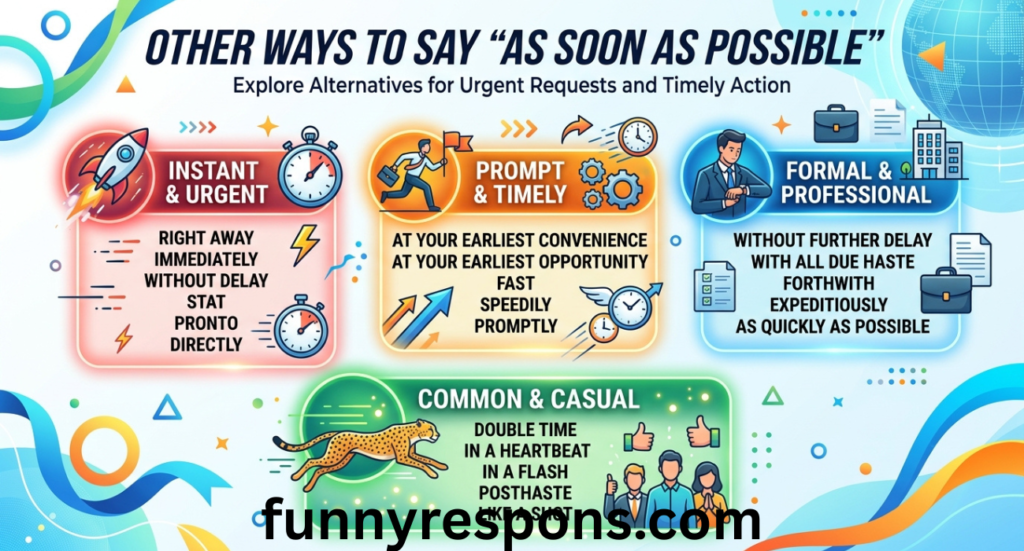
At the earliest possible opportunity is a formal alternative to “as soon as possible” that emphasizes taking action at the first suitable chance. It works particularly well in professional correspondence, business instructions, official notices, and workplace communication. The phrase sounds serious without necessarily demanding instant action, making it useful when timing matters but circumstances may affect when someone can respond.
For example, “Please review the contract at the earliest possible opportunity” tells the reader that the matter deserves prompt attention while allowing reasonable flexibility. Because the expression is somewhat formal and lengthy, simpler alternatives may work better in casual conversations. Use it when you want your message to sound deliberate, professional, and appropriately urgent without creating pressure for immediate action.
Read Also : 35 Other Ways to Say “I Miss You” – Heartfelt Alternatives to Express Your Feelings
36. As Quickly As Possible: A Direct Alternative to ASAP
As quickly as possible is a straightforward alternative that emphasizes speed without adding unnecessary formality. It works well in workplace emails, project discussions, instructions, and everyday requests. The expression clearly tells the reader that you want fast action, but it still leaves the exact timeframe open. For important deadlines, combine it with a specific date or time for clarity.
For example, “Please send the invoice as quickly as possible” is direct and easy to understand. This phrase can sound slightly more urgent than “when you have a chance,” yet it remains less forceful than “immediately.” Use it when speed matters and the recipient understands the surrounding context. If priorities may conflict, explain the reason for urgency so they can respond appropriately today.
37. At Your Earliest Opportunity: A Polished Alternative to ASAP
At your earliest opportunity is a polished phrase that asks someone to act when the next suitable chance becomes available. It balances urgency and flexibility, which makes it useful in professional emails, workplace requests, and client communication. The expression sounds courteous without being overly casual. It is especially helpful when you need attention soon but cannot reasonably demand immediate action.
For example, “Please review these figures at your earliest opportunity” encourages prompt attention without imposing a rigid deadline. It can sound more formal than “when you get a chance,” so consider the relationship and setting before using it. If the recipient needs to prioritize the task over other work, provide a clear deadline. Specific timing always reduces unnecessary guesswork today.
38. At the Soonest Possible Time: A Formal ASAP Alternative
At the soonest possible time is a formal expression that communicates a strong preference for quick action. It can fit professional correspondence when you want to emphasize that a task should not be delayed. The phrase focuses on speed while leaving some flexibility around the exact timing. It works best in serious workplace situations where polished wording supports the message effectively.
For example, “Please arrange the meeting at the soonest possible time” signals that scheduling should receive prompt attention. However, the wording may feel somewhat stiff in casual communication. Before choosing it, consider whether a shorter alternative would sound more natural. If timing is important enough to affect priorities, state the desired deadline directly instead of relying only on urgency today.
39. With All Possible Speed: A Strong Formal Alternative to ASAP
With all possible speed is a strong alternative that emphasizes completing something quickly while still sounding formal. It can suit official communication, serious workplace situations, or requests where delay could cause meaningful problems. Because the expression carries noticeable urgency, it should not be used for routine tasks. Save it for circumstances where speed genuinely deserves special attention today.
For example, “Please process the request with all possible speed” makes the priority clear. The phrase can sound old-fashioned or highly formal in everyday American English, so simpler wording may often be preferable. If you need a natural workplace expression, “as quickly as possible” may feel smoother. For formal notices, however, this option can effectively communicate seriousness and urgency today.
40. As Soon As It Works for You: A Flexible Alternative to ASAP
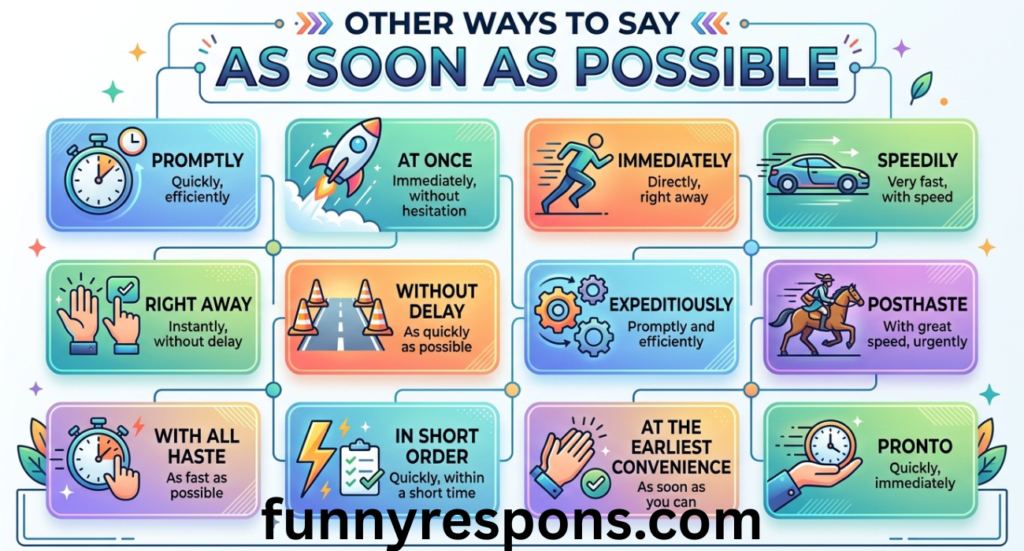
As soon as it works for you is a flexible, reader-friendly alternative that recognizes the recipient’s schedule. It asks for prompt action without imposing a strict deadline or suggesting that the person should drop everything. This wording fits casual professional emails, coworker messages, client communication, and everyday requests where cooperation matters more than immediate completion or rigid timing overall.
For example, “Please send the updated file as soon as it works for you” sounds considerate and approachable. It is especially useful when you want to avoid sounding demanding. However, it may be too flexible when a deadline matters. In those situations, provide a specific date or time instead. Clear expectations help recipients understand exactly when you need the task completed.
How to Choose the Best Alternative to “As Soon As Possible”
The strongest alternative isn’t always the most formal one. Choose the phrase that accurately communicates the urgency you actually mean. A request for something “when possible” has a very different expectation from a request for something “immediately.”
| Phrase | Tone | Urgency | Best for |
| At your earliest convenience | Polite/formal | Medium | Business emails |
| As soon as you can | Friendly | Medium | Coworkers and everyday requests |
| When you have a moment | Gentle | Low | Internal communication |
| Promptly | Professional | High | Time-sensitive tasks |
| Without delay | Firm | Very high | Critical requests |
| When possible | Flexible | Low | Non-urgent tasks |
| Right away | Casual/direct | Very high | Chats and everyday messages |
| Immediately | Firm | Extreme | Emergencies and critical matters |
| As a priority | Professional | High | Workplace task management |
| When time allows | Relaxed | Low | Flexible requests |
How to say “as soon as possible” politely
If you want to sound polite, choose wording that respects the other person’s time. “Could you send the file as soon as you can?” sounds warmer than “Send the file ASAP.”
For a formal email, “Please send the completed form at your earliest convenience” is a conventional option. Cambridge specifically identifies this phrase as a formal way to ask someone to act as soon as they can.
Still, politeness shouldn’t come at the cost of clarity. If you need something by Friday, say so. A clear deadline often helps more than a softer phrase.
How to say ASAP professionally
A professional request should tell the recipient what you need, why you need it, and when you need it.
Instead of:
“Please send the report ASAP.”
Try:
“Could you send the report by noon tomorrow? We need it for the client meeting.”
That version removes guesswork. Grammarly’s guidance similarly favors specific deadlines because “as soon as possible” doesn’t establish a concrete timeframe.
Formal vs. casual alternatives to ASAP
Formal communication often favors phrases such as promptly, at your earliest opportunity, or without delay. Casual conversations usually sound better with “as soon as you can,” “right away,” or “when you get a chance.”
Your relationship with the reader matters, too. A message to a senior executive shouldn’t necessarily sound like a text to a close friend. Match your language to the setting.
When “as soon as possible” is better than an alternative
There are times when the original phrase works perfectly well. If everyone understands the urgency and the exact timing isn’t important, “as soon as possible” is direct and familiar.
The problem starts when people use it for every request. If one email says “ASAP” for a major deadline and another uses it for a task that can wait three days, the recipient has to guess which request deserves priority. Overuse can make urgency less meaningful.
The best alternative: give a specific deadline
When timing matters, specificity usually beats clever wording.
Compare these two requests:
Vague: “Please send the contract as soon as possible.”
Clear: “Could you send the signed contract by 2 p.m. Thursday? We need to submit it before the client review.”
The second request gives the recipient a finish line. It also explains the reason behind the deadline, which makes cooperation easier.
Professional email guidance likewise emphasizes a focused message, a clear call to action, and a timeframe when appropriate.
How urgency changes the right phrase
Think of urgency as a sliding scale rather than a single category.
For a low-priority task, “when time allows” may be enough. For a normal workplace request, “as soon as you can” feels natural. For a deadline-driven assignment, “promptly” or “as a priority” makes more sense. For an emergency, “immediately” leaves no room for ambiguity.
The key is alignment. Your wording should match the actual consequences of waiting.
What to use in a professional email
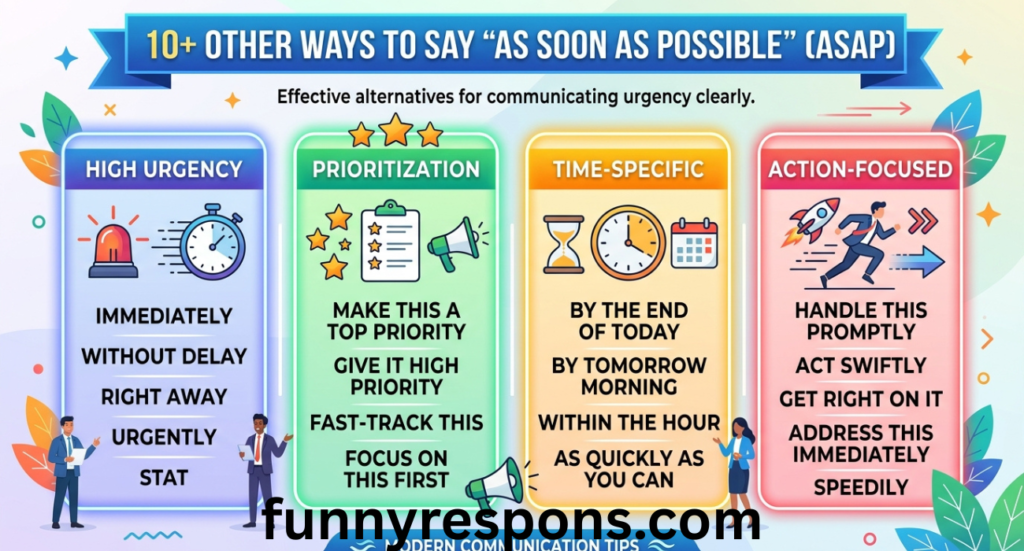
For a professional email, avoid relying on a single urgency word without context. Instead, pair the request with a reason or deadline.
For example:
“Could you review the proposal by Wednesday afternoon? I’d like to incorporate your feedback before the client call.”
This approach sounds respectful while giving the reader useful information. It also reduces the chance that your message will sound bossy, vague, or unnecessarily urgent.
What to use with coworkers
Coworkers usually respond well to direct but friendly language. “When you get a chance,” “as soon as you can,” and “when you have a moment” work well for routine tasks.
When the task has a deadline, switch to precise wording. “Could you update the spreadsheet by 4 p.m.?” gives your teammate a clear target without sounding aggressive.
What to use with clients and customers
Client communication requires extra care because tone can influence the relationship. A phrase such as “at your earliest opportunity” can sound polished, while a specific deadline can prevent confusion.
For example:
“Please send the signed approval by Friday so we can keep the project on schedule.”
That’s often better than simply writing “Please send it ASAP.” The client knows exactly what action you need and why it matters.
Other Ways to Say As Soon As Possible in Professional Emails
Choosing the right alternative can make a professional email sound more respectful and precise. Instead of repeating “as soon as possible,” consider wording that matches the urgency and relationship. A thoughtful phrase can encourage action without creating unnecessary pressure. It also helps readers understand whether you need immediate attention, a prompt response, or simply completion within a reasonable timeframe today.
For example, “Please review the attached proposal at your earliest convenience” sounds courteous and professional. Meanwhile, “Please send the figures as quickly as possible” communicates stronger urgency. The best choice depends on your deadline, audience, and workplace culture. When timing is critical, avoid vague language altogether and provide a specific date or time whenever practical for everyone involved.
Polite Alternatives to As Soon As Possible for Work
Workplace communication often requires urgency without sounding demanding. Polite alternatives to “as soon as possible” help you maintain a cooperative tone while still requesting timely action. Expressions such as “when you have a moment” or “as soon as you can” can soften requests. They work especially well when colleagues already understand the task and its surrounding priorities clearly.
Consider your relationship with the recipient before choosing your wording. A teammate may respond naturally to casual language, while a client may expect something more polished. If the request affects an important deadline, combine a courteous phrase with an exact timeframe. This approach keeps your message friendly while making expectations clear, practical, and easier for everyone to follow today.
Professional Ways to Request a Quick Response
When you need a quick response, your wording should communicate urgency without sounding impatient. Professional alternatives to “as soon as possible” can help you make the request more effectively. Phrases such as “at your earliest opportunity” or “when possible” offer flexibility, while expressions like “promptly” and “without delay” create a stronger sense of urgency when circumstances require faster action.
A clear request also explains what you need from the recipient. Instead of writing only “Please respond as soon as possible,” specify the information or action required. You can then add a deadline, such as “Please reply by Thursday afternoon.” This structure removes uncertainty and helps the reader understand exactly what action matters and when you need it completed.
Best Alternatives to As Soon As Possible for Emails

Email wording can influence how your request is received, especially when the recipient cannot hear your tone of voice. Replacing “as soon as possible” with a more specific expression can make your message sound thoughtful and professional. Choose phrases that reflect the actual urgency, whether you need something immediately, later today, or whenever the recipient becomes available to respond.
For example, “Please send the signed form at your earliest opportunity” sounds polished without demanding instant action. If you need the form today, say so directly. A sentence like “Please send the signed form by 3 p.m. today” gives the recipient a measurable expectation. Specific deadlines often communicate urgency more effectively than broad expressions alone in professional email.
Formal Alternatives to As Soon As Possible
Formal communication sometimes calls for more polished wording than everyday expressions. Alternatives such as “at the earliest possible opportunity,” “as soon as circumstances permit,” and “without delay” can suit official correspondence and business documents. These phrases communicate urgency while maintaining a professional tone. However, formal language should remain clear rather than becoming unnecessarily complicated for the reader.
Before choosing a formal alternative, consider whether your audience actually expects formal language. A long expression can make a simple request feel unnecessarily stiff. In many business situations, concise wording is more effective. If the matter has a firm deadline, state that deadline directly. Clear language helps readers act confidently and reduces the chance of misunderstandings about timing.
Casual Alternatives to As Soon As Possible
Casual conversations usually benefit from simple, natural wording. Instead of saying “as soon as possible,” you can use phrases such as “when you get a chance,” “when you have a moment,” or “as soon as you can.” These alternatives sound friendly and relaxed while still communicating that you would appreciate attention. They work well with friends, coworkers, and familiar contacts.
The right phrase depends on how urgent the request actually is. “When you get a chance” suggests flexibility, while “as soon as you can” creates more urgency. Avoid using a relaxed expression when you genuinely need immediate action. If the task affects a deadline, explain the timing clearly. A friendly tone should never leave important expectations unclear for anyone involved.
How to Say As Soon As Possible Without Sounding Rude
“As soon as possible” can sometimes sound demanding because it places emphasis on speed without explaining the circumstances. A softer alternative can make the same request feel more respectful. Phrases such as “at your earliest convenience” or “as soon as you are able” recognize the recipient’s schedule. This small wording change can make workplace communication feel more cooperative.
You can also reduce pressure by briefly explaining why you need the task completed quickly. For instance, “Could you send the report when you have a moment? We need it for tomorrow’s meeting.” This gives useful context instead of simply demanding speed. When urgency is genuine, a clear reason and reasonable deadline often create a better response than forceful wording alone.
As Soon As Possible Alternatives With Specific Deadlines
Sometimes the best alternative to “as soon as possible” is a specific deadline. Broad phrases can leave readers wondering whether you mean within minutes, several hours, or a few days. Adding a precise timeframe removes that uncertainty. For example, “Please send the document by noon Friday” tells the recipient exactly what you need and when the task should be finished.
You can combine a polite expression with a deadline when you want both courtesy and clarity. Try saying, “Please review the proposal at your earliest convenience, ideally by Wednesday afternoon.” This approach leaves some flexibility while establishing a useful target. It works particularly well for projects, business emails, client requests, scheduling, and tasks involving several competing priorities at work.
Urgent Alternatives to As Soon As Possible
When a situation genuinely requires immediate attention, choose wording that reflects the level of urgency. “Immediately,” “right away,” “without delay,” and “at once” communicate stronger urgency than softer alternatives. These expressions should be reserved for situations where postponing action could create a meaningful problem. Otherwise, they may make routine requests sound unnecessarily serious or demanding.
If the request is urgent, explain what makes it urgent whenever appropriate. For example, “Please contact the customer immediately because the shipment is scheduled for pickup today.” This gives the recipient useful context and helps them prioritize. For less serious situations, choose a calmer expression such as “promptly” or “as soon as you can” to avoid overstating the urgency unnecessarily.
How to Choose the Right Alternative to As Soon As Possible
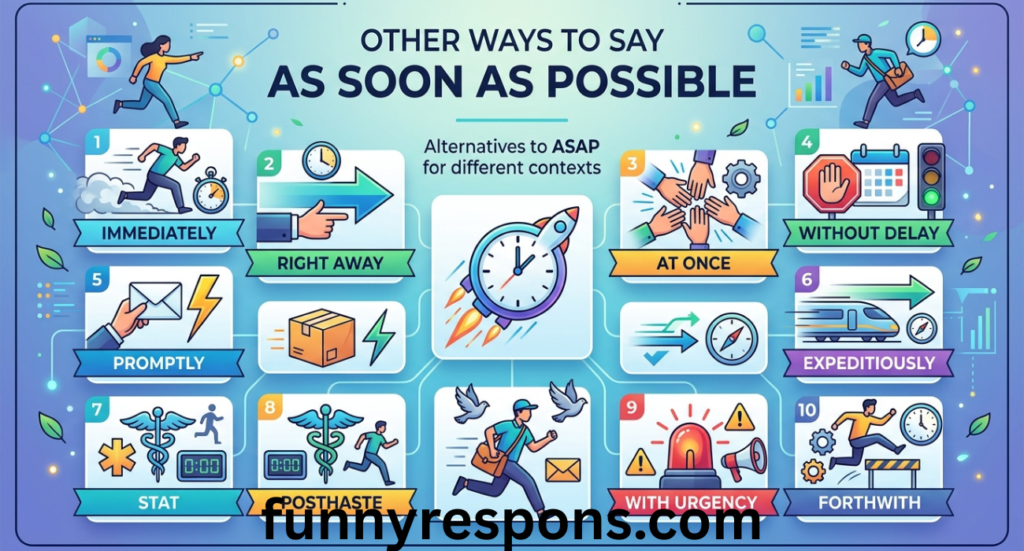
The best alternative depends on urgency, formality, audience, and timing. Start by deciding how quickly you genuinely need the action completed. Then consider whether you are writing to a coworker, manager, client, customer, friend, or another contact. Finally, choose wording that matches the relationship. This simple process helps your request sound natural rather than forced or overly formal.
When the timing is important, prioritize clarity over clever wording. A specific deadline is often stronger than any substitute phrase because it tells the reader exactly what to expect. For flexible requests, use polite expressions that acknowledge the recipient’s schedule. For urgent matters, choose direct language and explain the reason. Matching words to circumstances makes communication more effective and professional overall.
FAQs
What Is Another Way to Say “As Soon As Possible”?
Common alternatives include “as soon as you can,” “at your earliest convenience,” “promptly,” “without delay,” and “right away.”
How Do You Say “As Soon As Possible” Politely?
Use phrases like “at your earliest convenience” or “when you have a moment” to request quick action without sounding demanding.
What Is a Professional Way to Say “As Soon As Possible”?
“At your earliest opportunity,” “promptly,” and “as soon as reasonably possible” are professional alternatives that work well in workplace emails.
Is “As Soon As Possible” Professional?
Yes, “as soon as possible” is professional, but it can be vague. For important tasks, a specific deadline is usually clearer.
Conclusion
Choosing the right words can make your message clear and polite. Other Ways to Say As Soon As Possible give you more choices for different situations. You can use “at your earliest convenience” for a polite request or “right away” when you need quick action. You can also use a specific deadline when the exact time matters. These simple choices help your reader understand your request without stress.
Always think about your reader and the level of urgency before choosing a phrase. A friendly request may need soft words, while an urgent task may need stronger words. Good communication should sound clear, respectful, and direct. By using the right alternative, you can make emails, school messages, and workplace notes easier to understand and more professional.