Coach’s vs Coaches’ vs Coaches: What’s the Real Difference?
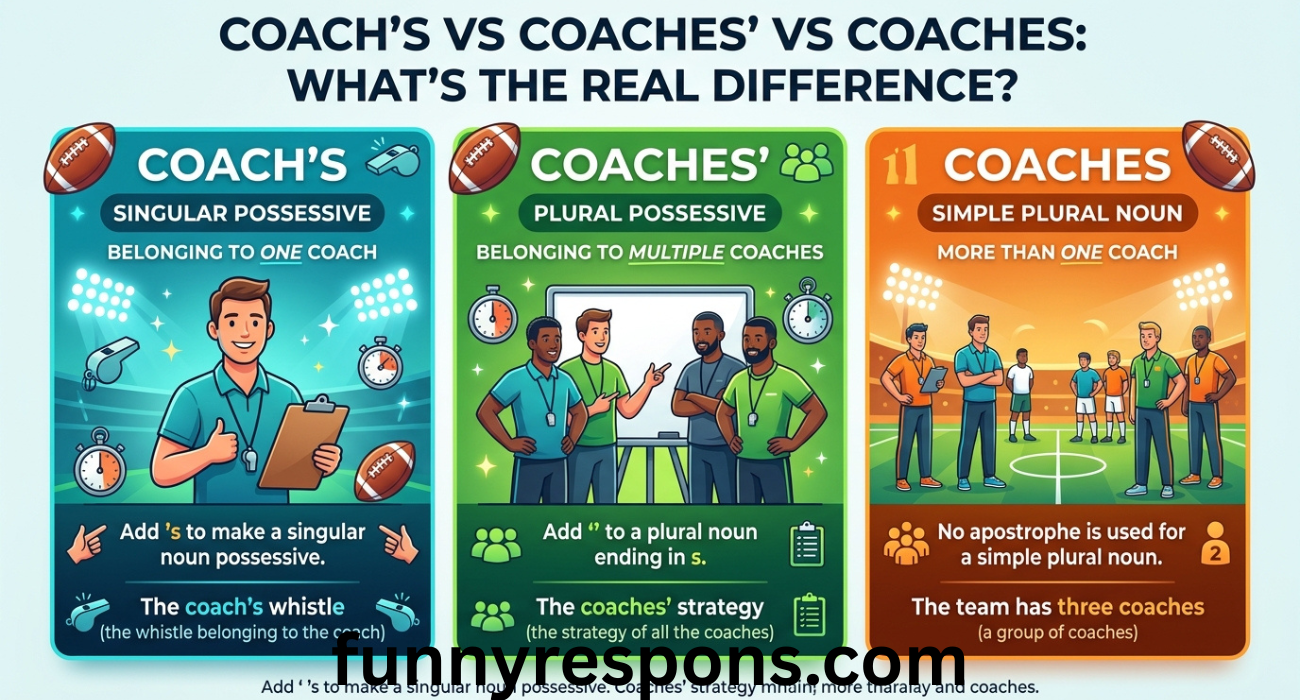
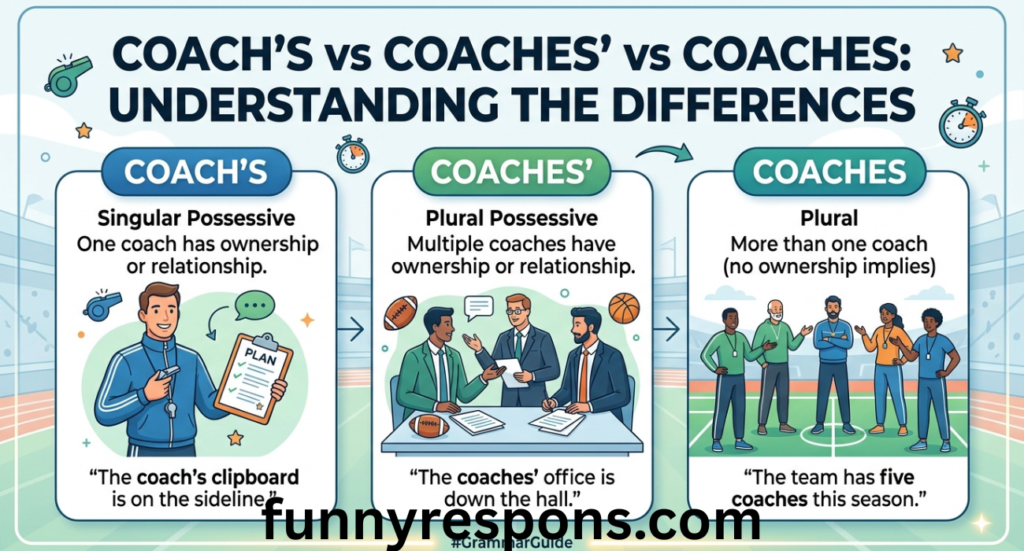
Coach’s vs Coaches’ vs Coaches can look confusing in English. Coach’s means something belongs to one coach. Coaches’ means something belongs to two or more coaches. Coaches simply means more than one coach. Each form has a different use in a sentence.
Small apostrophe marks can change the meaning of a sentence. Using the wrong form can make your writing unclear. Learning this simple rule can help you write with confidence. Once you understand the difference, these words become easy to use.
Coach’s vs Coaches’ vs Coaches follows a simple grammar rule. Use coach’s for one coach with possession. Use coaches’ for several coaches with possession. Use coaches when you only mean more than one coach.
When to Use Coach’s vs Coaches: Real-Life Examples
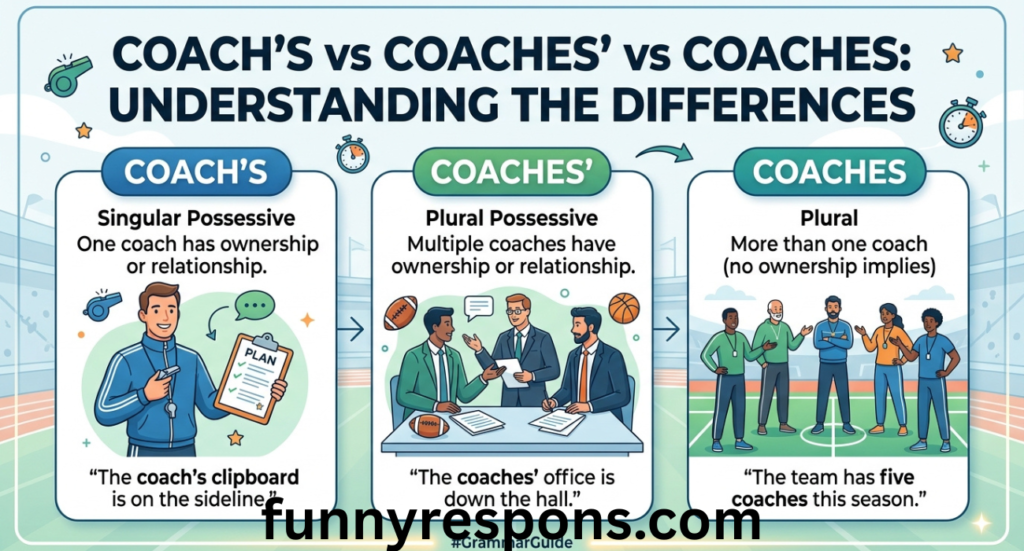
The easiest way to understand Coach’s vs Coaches’ vs Coaches is to start with real situations. Imagine a high school basketball team after practice. If one coach leaves a whistle on the bench, you could write, “The coach’s whistle was on the bench.” Only one coach owns or uses the whistle in this sentence, so the singular possessive form works.
Now imagine three coaches sharing responsibility for the team. You might write, “The coaches’ meeting starts at 4 p.m.” The meeting belongs to or involves multiple coaches, so the apostrophe comes after the plural s.
Finally, consider this sentence: “The coaches arrived early.” Nothing belongs to the coaches here. The word simply identifies more than one coach. That makes coaches a simple plural.
| Form | What it means | Example |
| Coach’s | One coach owns or is connected to something | The coach’s office is upstairs. |
| Coaches’ | Multiple coaches own or share something | The coaches’ meeting starts soon. |
| Coaches | More than one coach | The coaches arrived early. |
This distinction comes down to possessive nouns and possessive forms. A possessive form indicates a relationship such as ownership, responsibility, association, or connection. The relationship doesn’t always mean literal ownership. For example, “the coach’s decision” doesn’t mean the coach physically owns the decision. It means the coach made it.
Read Also : 35 Other Ways to Say “I Miss You” – Heartfelt Alternatives to Express
A quick test for Coach’s vs Coaches’ vs Coaches
Ask yourself, “Am I talking about one coach, several coaches, or something owned by one or several coaches?”
If you mean one coach with singular ownership, choose coach’s. If several coaches share plural ownership, choose coaches’. If you simply mean multiple coaches, use coaches.
That simple question solves most grammar rules involving these three forms.
Apostrophe Rules Simplified: Coaches’ Explained
Here is the rule that causes the most apostrophe confusion: when a regular plural noun already ends in s, add only an apostrophe to show possession.
For example:
- one coach → coach’s
- two coaches → coaches’
- several coaches with no possession → coaches
The punctuation rule is straightforward. A singular noun normally takes ’s for possession, while a regular plural noun ending in s takes an apostrophe after the final s. The MLA Style Center explains the same basic distinction: singular nouns and irregular plurals generally take ’s, while plural nouns ending in s take an apostrophe alone. MLA Style Center
Consider these examples:
“The coach’s strategy worked.”
One coach created the strategy.
“The coaches’ strategy worked.”
Multiple coaches created or shared the strategy.
“The coaches celebrated after the game.”
There is no ownership at all.
The important point is that plural nouns and possessives are not the same thing. Adding an s normally makes a regular noun plural. Adding an apostrophe changes the grammatical relationship.
Why the apostrophe matters
Think of the apostrophe as an ownership indicator. It tells the reader that the noun has a possessive relationship with another word.
“The coaches arrived” tells you who arrived.
“The coaches’ office was locked” tells you whose office it was.
That small mark carries useful information. Correct possessive punctuation improves grammar clarity because the reader doesn’t have to stop and guess what you mean.
How to Teach Apostrophes Using Coach’s and Coaches’
Teaching apostrophes becomes easier when students can picture the difference. Instead of beginning with complicated terminology, start with one coach and then add another.
Picture Coach Maria standing beside a clipboard. The clipboard belongs to her, so you write, “Coach Maria’s clipboard.” Now picture three coaches sharing a team schedule. You can write, “The coaches’ schedule.”
This approach works well as a teacher’s guide because students see the grammatical relationship instead of memorizing symbols in isolation.
A useful classroom activity is to give students three cards labeled “one coach,” “many coaches,” and “ownership.” Students combine the cards to create forms such as “coach’s,” “coaches’,” and “coaches.” This becomes a simple education resource that turns grammar into something active.
For younger grammar learners, sports examples can make the lesson more memorable. Ask students to complete sentences such as:
“The ______ whistle was missing.”
“The ______ arrived before practice.”
“The ______ meeting lasted an hour.”
Students must decide whether the sentence describes one owner, multiple owners, or simply a group.
Build the rule through repetition
Good writing practice doesn’t require dozens of identical sentences. Instead, vary the context. Use basketball, football, soccer, school clubs, summer camps, and workplace training.
The goal is to help students develop apostrophe skills rather than memorize one isolated example.
Why Coaches’ Apostrophe Confusion Happens So Often
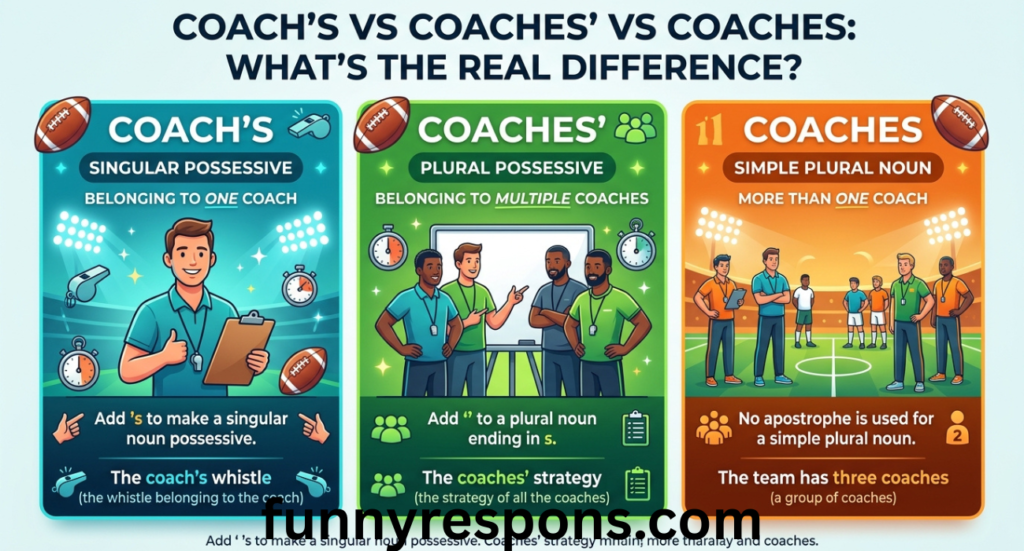
The form coaches’ causes trouble because the plural coaches already looks complete. Adding an apostrophe creates only a tiny visual difference, yet that mark changes the function of the word.
Compare:
“The coaches talked after practice.”
“The coaches’ meeting started at noon.”
In the first sentence, coaches is simply plural. In the second, coaches’ shows a possessive relationship.
This is a classic case of context in grammar. The surrounding words help reveal what the writer means. Words such as “meeting,” “strategy,” “office,” “schedule,” and “feedback” often signal a possible possessive relationship.
Many apostrophe errors happen because writers think every word ending in s follows the same pattern. It doesn’t. Writers need to distinguish a plural from a possessive.
The problem becomes especially noticeable in fast writing. A student may type “the coaches strategy” because the sentence sounds almost identical when spoken. A copyeditor may catch it immediately because written English depends on visual punctuation as well as sound.
That is why context clues matter. Ask who owns, created, controls, or is associated with the following noun.
Quick Quiz: Test Your Knowledge on Coach’s and Coaches’
Ready for a quick grammar practice session? Choose the correct form in each sentence.
- The ______ whistle fell onto the field.
- The ______ arrived ten minutes early.
- The ______ meeting lasted nearly two hours.
- The assistant reviewed the ______ schedule.
- Two ______ spoke at the event.
Answers
- coach’s — one coach owns or uses the whistle.
- coaches — the sentence simply refers to multiple coaches.
- coaches’ — several coaches are associated with the meeting.
- coaches’ — the schedule belongs to or concerns multiple coaches.
- coaches — the word identifies more than one coach.
Use this as a quick learning check after studying the rule. If you miss one, don’t memorize the answer. Instead, identify the number of owners and ask whether the sentence expresses possession.
The Role of Apostrophes in Sports Terminology
Sports language provides some of the clearest examples of possessive forms. A game story might mention “the coach’s decision,” while another report could discuss “the coaches’ reactions.”
In sports writing, small punctuation choices can affect meaning. A sports reporter needs to distinguish between one coach’s statement and comments from an entire coaching staff.
The same principle applies to sports journalism. Consider:
“The coach’s comments surprised the players.”
“The coaches’ comments surprised the players.”
The first sentence points to one coach. The second points to several.
This matters in sports terminology because sports stories frequently describe decisions, strategies, opinions, facilities, schedules, and reactions connected to individuals or groups.
Even short sports headlines benefit from precise grammar. A headline such as “Coach’s Challenge Changes Game” identifies one coach. “Coaches’ Concerns Grow” identifies concerns shared by several coaches.
In sports reports and sports articles, accurate apostrophes help readers process information quickly. When space is limited, punctuation has to do its job without creating confusion.
How Context Changes Meaning: Coach’s vs Coaches’
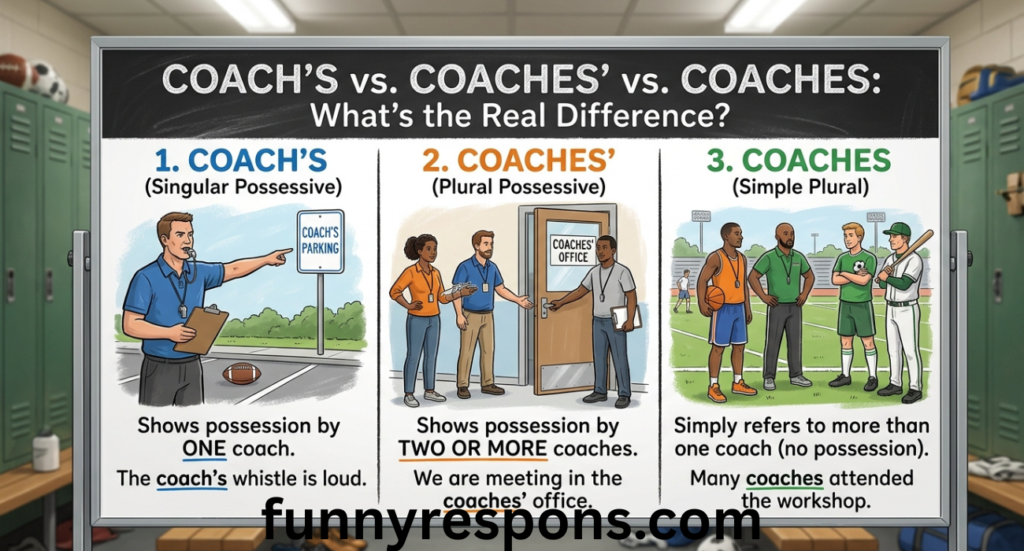
Context can completely change the meaning of a sentence. Consider these three examples:
“The coach’s strategy impressed the team.”
“The coaches’ strategy impressed the team.”
“The coaches impressed the team.”
The first sentence describes one coach’s strategy. The second describes a strategy belonging to or developed by multiple coaches. The third says nothing about ownership. It simply identifies the coaches as the people who impressed the team.
This is why singular ownership and plural ownership deserve separate attention. The number of owners determines where the apostrophe goes.
A useful editing question is: “How many people are connected to the noun after the possessive?”
If one coach owns, creates, controls, or provides something, use coach’s.
If several coaches share that relationship, use coaches’.
If no possessive relationship exists, use coaches.
When ownership isn’t literal
Possession in grammar doesn’t always mean something physically belongs to someone. English uses possessive forms for relationships and associations too.
“The coach’s advice” means advice given by the coach.
“The coaches’ feedback” means feedback provided by several coaches.
“The coach’s team” identifies the team associated with the coach.
Understanding this broader idea of ownership makes possessive forms much easier to recognize.
Apostrophe Mistakes That Make You Look Unprofessional
A tiny punctuation error can weaken otherwise strong writing. Consider a formal email that says, “Please review the coaches report.” The reader can probably understand the intended meaning, but the missing apostrophe makes the sentence look unfinished.
The correct version is “Please review the coaches’ report” if several coaches prepared or own the report.
These errors appear in professional emails, reports, presentations, websites, and internal documents. They can also appear in school essays and application materials.
That doesn’t mean one missing apostrophe ruins your credibility. However, repeated mistakes can create the impression that the writer didn’t proofread carefully.
In professional writing, accuracy supports trust. Clear punctuation also contributes to writing credibility, especially when the audience expects polished communication.
The best approach isn’t to panic over every apostrophe. Instead, build a reliable editing habit.
Editing Tips: Spotting Coach’s and Coaches’ Errors Fast
A fast proofreading method can catch most mistakes before publication.
First, locate the noun that appears to show possession. Then ask how many owners exist. Finally, check the apostrophe.
Try the “of” test:
“The whistle of the coach” becomes “the coach’s whistle.”
“The meeting of the coaches” becomes “the coaches’ meeting.”
This technique works because it exposes the relationship between the owner and the thing connected to it.
Your editing process should also include reading important sentences aloud. Speaking won’t always reveal an apostrophe mistake, but it can expose awkward wording and unclear relationships.
A strong grammar mindset treats punctuation as part of meaning rather than decoration. During your regular writing routine, spend a few seconds checking possessive nouns before you submit an assignment or publish an article.
Don’t rely entirely on automated spelling tools. A grammar checker may recognize some grammar inaccuracy, but software doesn’t always understand the intended meaning of a sentence.
Coach’s, Coaches’, and Coaches: A Grammar Cheat Sheet
When you need a quick reference, use this grammar cheat sheet:
| Form | Function | Example |
| Coach’s | Singular possessive | The coach’s office is locked. |
| Coaches’ | Plural possessive | The coaches’ office is locked. |
| Coaches | Simple plural | The coaches are meeting. |
The quickest memory rule is even shorter:
One coach owns something → coach’s.
Several coaches own something → coaches’.
Several coaches with no ownership → coaches.
This three-line rule handles most everyday uses.
For grammar learners, the key isn’t memorizing the spelling alone. You need to recognize the grammatical job each form performs.
How to Fix Apostrophe Errors in Your Writing Instantly
When you see a phrase such as “the coaches plan,” don’t immediately add an apostrophe. First ask what the sentence means.
If one coach created the plan, write:
“The coach’s plan.”
If several coaches created the plan, write:
“The coaches’ plan.”
If you are describing coaches rather than ownership, you might write:
“The coaches planned the session.”
That distinction is the heart of the grammar fix.
A three-step method works well:
- Find the person or group connected to the noun.
- Count how many people are involved.
- Decide whether the relationship shows possession or simply describes a group.
This method is faster and more reliable than trying to remember punctuation by appearance alone.
Coaches or Coach’s? The Ultimate Usage Guide for Beginners
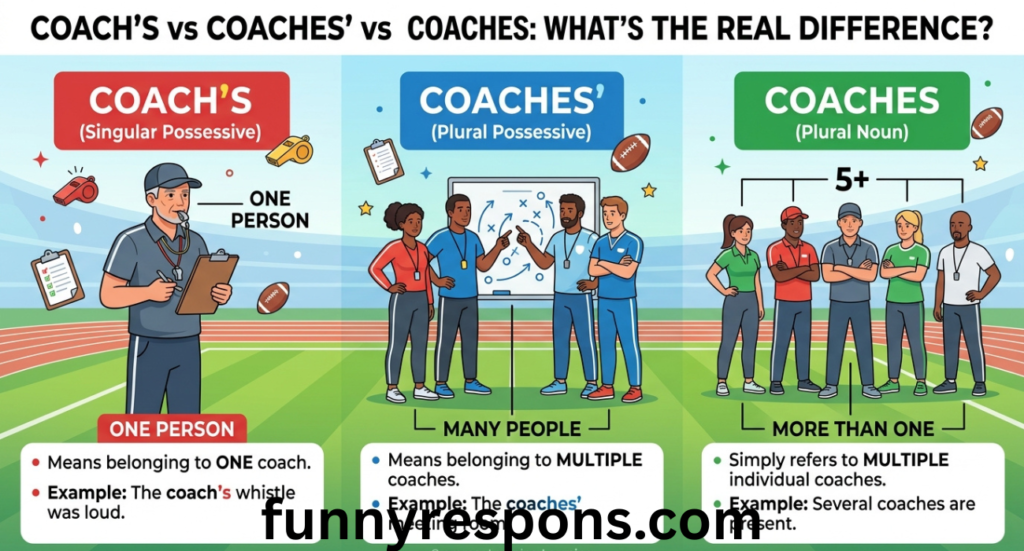
Beginners often use coaches whenever they see a sentence involving a coach. The problem is that plural and possessive forms perform different jobs.
Compare:
“The two coaches were experienced.”
“The coach’s speech was inspiring.”
“The coaches’ speeches were inspiring.”
The first sentence uses the plural form. The second uses the singular possessive. The third uses the plural possessive.
Notice how the noun after the possessive also gives you a clue. “Speech” belongs to one coach in the second sentence. “Speeches” are connected to multiple coaches in the third.
This is one reason apostrophe guidelines are easier to apply when you look at the entire phrase rather than one word.
When in doubt, don’t ask, “Which spelling looks right?” Ask, “What does this sentence mean?”
Read Also : 40 Best Ways to Say “Nice to See You Again” (Meaning, Professional Uses
Fun Ways to Remember Coach’s vs Coaches’ Rules
Grammar becomes easier when you attach a strong image to the rule.
Imagine one coach standing alone with a whistle. That is coach’s.
Now imagine several coaches standing together around a whiteboard. Their shared whiteboard is the coaches’ whiteboard.
Finally, imagine those coaches walking into a gym. They are simply coaches.
These mnemonics create a visual distinction between the three forms. You can also use visual memory tools such as color coding:
- One coach = blue
- Multiple coaches with ownership = green
- Multiple coaches without ownership = red
Another useful memory trick is to think of the apostrophe as a small flag that marks a possessive relationship. No ownership? No flag.
The more often you apply the rule in different situations, the closer you get to genuine grammar mastery.
What Style Guides Say About Using Coach’s and Coaches’
Major American style references agree on the core rule used in this article. The MLA Style Center states that singular nouns and irregular plurals generally form possessives with ’s, while plural nouns ending in s take an apostrophe alone. MLA Style Center
The Chicago Manual of Style follows the same basic pattern for regular plural possessives. Chicago also distinguishes plural possessives from singular nouns ending in s, which can create a different question in examples such this pattern becomes automatic, apostrophes stop feeling like a grammar trap. They become what they should be: small punctuation marks that make your meaning sharper, your writing cleaner, and your message easier to understand. as proper names. The Chicago Manual of Style Online+1
That last point is worth remembering because not every word ending in s is plural. For example, Chicago recommends forms such as “Kansas’s” because Kansas is singular. By contrast, a plural form such as “the United States” takes an apostrophe alone in the possessive. The Chicago Manual of Style Online+1
For everyday uses of “coach,” however, the rule is uncomplicated. Coach’s is singular possessive, coaches’ is plural possessive, and coaches is plural.
If you’re following APA, MLA, or Chicago, consult the current manual when a specialized situation falls outside this basic pattern. Style guides can differ on some edge cases, particularly names and specialized constructions, even when the ordinary plural possessive rule remains consistent.
How Apostrophes Impact Reader Understanding
Apostrophes help readers understand relationships quickly. Without them, some phrases become ambiguous or simply look unfinished.
Compare:
“The coach’s orders were clear.”
“The coaches’ orders were different.”
“The coaches gathered outside.”
Each sentence gives the reader different information.
The first identifies one coach. The second identifies multiple coaches. The third simply identifies a group.
That difference supports reader understanding because punctuation reduces the amount of guesswork required. Good punctuation contributes to clear writing, especially when a sentence contains several nouns.
It also improves communication clarity. A reader shouldn’t have to reread a sentence to figure out whether one person or several people are involved.
This matters in academic and professional settings. Academic credibility depends partly on presenting ideas carefully, while clear workplace writing supports efficient business communication.
Social Media Grammar: Coach’s vs Coaches’ in Posts
Short social media posts may feel informal, but punctuation still affects meaning.
Imagine a youth soccer team posting:
“We’re celebrating our coach’s hard work!”
That sentence refers to one coach.
Now imagine the team has several coaches:
“We’re celebrating our coaches’ hard work!”
The second version tells followers that multiple coaches deserve recognition.
In social media captions, a missing apostrophe can create an awkward impression. The same applies to team announcements, promotional posts, newsletters, and profile descriptions.
The goal isn’t to make every caption sound stiff. Good social content can remain friendly and conversational while using accurate grammar.
Before publishing, scan for possessives involving people, teams, departments, and organizations. A ten-second check can prevent a needless correction later.
Business Writing Tips: Using Coach’s and Coaches’ Correctly
Professional communication often contains phrases involving managers, trainers, instructors, teams, and departments. The same possessive rule applies.
For example:
“Please review the coach’s feedback.”
One coach provided the feedback.
“Please review the coaches’ feedback.”
Several coaches provided the feedback.
“Please contact the coaches.”
The sentence simply refers to multiple coaches.
This distinction matters in business communication because ambiguity can cause practical problems. A training company might have one lead coach or an entire coaching department. The sentence should make that difference obvious.
The same principle applies to schedules, reports, evaluations, policies, and meeting notes. If you’re preparing professional emails, ask who owns or provides the information before adding the apostrophe.
Good workplace writing also benefits from a professional tone. Correct punctuation doesn’t make a message formal by itself, but careful grammar supports a polished presentation.
Is Coach’s or Coaches’ Correct in American English?
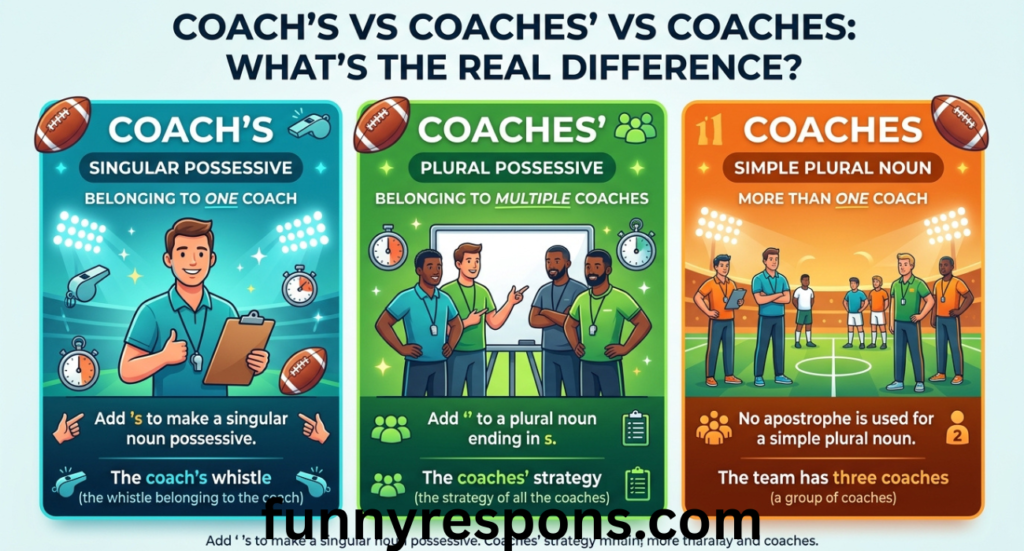
American English follows a clear pattern when choosing between coach’s and coaches’. Use coach’s when one coach owns, provides, or controls something. Use coaches’ when several coaches share that relationship. For example, “the coach’s advice” refers to one coach, while “the coaches’ advice” points to several coaches.
The word coaches works differently because it simply identifies more than one coach. It doesn’t show possession. For example, “The coaches arrived early” contains no possessive relationship. Understanding this basic distinction helps prevent apostrophe confusion and makes everyday writing more precise, especially in schools, sports programs, workplaces, and online communication.
Coach’s vs Coaches’ in Sentences: Easy Examples
Seeing the forms inside complete sentences makes the grammar much easier to understand. Consider “The coach’s locker was cleaned yesterday.” One coach has the locker. Now compare “The coaches’ locker room was renovated.” Several coaches use the room. Finally, “The coaches entered the gym” simply identifies multiple coaches without showing possession.
These examples demonstrate why context clues matter when deciding between possessive forms. Don’t choose an apostrophe simply because a sentence contains the word “coach.” Instead, identify the grammatical relationship first. Ask whether you’re describing one coach, multiple coaches, or something connected to one or more coaches.
When Should You Use Coaches Without an Apostrophe?
Use coaches without an apostrophe when you’re talking about two or more people who coach. The word functions as an ordinary plural noun in this situation. For example, “The coaches discussed the upcoming tournament.” Nothing belongs to the coaches in that sentence, so adding an apostrophe would create an unnecessary punctuation mark.
A useful test is to remove the noun that follows the word. If you’re simply describing people, coaches usually works. Sentences such as “Several coaches attended the conference” and “The coaches celebrated afterward” describe a group. They don’t express ownership, which means no apostrophe belongs in either sentence.
When Should You Use Coach’s With an Apostrophe?
Use coach’s when one coach has a possessive relationship with another noun. That relationship can involve ownership, responsibility, authorship, or association. For example, “The coach’s strategy changed the game” means one coach created or used the strategy. The apostrophe and s show that singular relationship clearly.
This rule applies across many situations. You might write “the coach’s office,” “the coach’s decision,” “the coach’s instructions,” or “the coach’s schedule.” In each example, one coach connects to the following noun. Recognizing this pattern gives you stronger grammar accuracy without requiring complicated grammatical terminology.
When Should You Use Coaches’ With an Apostrophe?
Choose coaches’ when several coaches have a possessive relationship with something. Because coaches already ends with s, the standard plural possessive form adds an apostrophe after that final letter. For example, “The coaches’ meeting begins at noon” indicates that multiple coaches are connected to the meeting.
The same pattern appears in phrases such as “coaches’ opinions,” “coaches’ schedules,” and “coaches’ strategies.” Notice that the apostrophe doesn’t come before the s. That’s because coaches is already plural. Learning this simple apostrophe rule eliminates one of the most common mistakes writers make.
Coach’s vs Coaches’ vs Coaches in Sports Writing
Sports writers frequently mention coaches, strategies, decisions, interviews, and team activities. That makes coach’s vs coaches’ vs coaches particularly important in sports content. “The coach’s decision surprised everyone” refers to one coach. “The coaches’ decisions surprised everyone” refers to several coaches. “The coaches celebrated” simply identifies the people involved.
Accurate grammar improves the quality of sports journalism because readers need to understand relationships quickly. A misplaced apostrophe can make a headline or game recap confusing. Whether you’re writing a local sports story, team newsletter, school article, or professional report, precise sports writing keeps information clear.
Coach’s vs Coaches’ in School Assignments
Students often encounter these forms in essays, reports, and classroom exercises. A sentence such as “The coach’s speech motivated the players” refers to one coach. However, “The coaches’ speeches motivated the players” refers to multiple coaches. The number of coaches determines the possessive form, while the meaning determines whether possession exists.
Teachers can use this distinction to strengthen students’ academic writing skills. Rather than memorizing isolated apostrophe examples, students should identify the owner first. This approach builds a practical grammar mindset that transfers to other possessive nouns and improves confidence when completing essays, assignments, and examinations.
Coach’s vs Coaches’ in Professional Communication
Professional communication requires clarity because small grammatical errors can distract readers from important information. Compare “Please review the coach’s report” with “Please review the coaches’ report.” The first refers to one coach’s report, while the second refers to a report connected to several coaches.
This distinction matters in training companies, athletic departments, schools, and businesses. Business communication often includes schedules, reports, evaluations, and recommendations. Correct possessive forms help employees understand who provided information or owns responsibility. Strong professional writing doesn’t need complicated language; it needs precise wording and careful punctuation.
Common Coach’s vs Coaches’ Grammar Mistakes
One frequent mistake is writing “the coaches strategy” when the intended meaning is “the coaches’ strategy.” Another is using “coach’s” when the sentence simply refers to multiple coaches. These errors usually happen because writers focus on how the sentence sounds instead of examining its grammatical structure.
To prevent these mistakes, identify the number of coaches first. Then determine whether the sentence expresses possession or simply names a group. This two-step method improves grammar clarity and reduces unnecessary apostrophe errors. It also makes proofreading faster because you’re checking meaning instead of relying on appearance alone.
How to Remember Coach’s and Coaches’ Apostrophe Placement
A simple memory method can make apostrophe placement almost automatic. Imagine one coach standing alone. The apostrophe belongs before the final s in coach’s. Now imagine several coaches standing together. Their plural form already ends in s, so the apostrophe goes afterward: coaches’.
For visual memory tools, picture the apostrophe as a small marker showing possession. One coach gets ’s. Multiple coaches get s’. Multiple coaches without possession get no apostrophe. This memory trick works because it connects punctuation with meaning rather than asking you to memorize arbitrary symbols.
Coach’s vs Coaches’ for Teachers and Students
Teachers can make possessive grammar easier by connecting the lesson to familiar situations. Ask students to describe a coach’s whistle, several coaches’ schedules, and a group of coaches. Each example forces students to consider both number and possession before choosing a form.
This method creates useful writing practice while developing stronger apostrophe skills. Students can then apply the same reasoning to words such as players, teachers, parents, and managers. Once they understand the pattern with “coach,” they can transfer the rule to many other regular plural nouns.
Does Coach’s Mean One Coach?
Yes, when coach’s functions as a possessive noun, it indicates one coach. The apostrophe followed by s marks a relationship between one coach and another noun. For example, “The coach’s notebook disappeared” means one coach has the notebook or is associated with it.
However, the relationship doesn’t always mean physical ownership. “The coach’s advice” describes advice given by one coach. “The coach’s decision” identifies a decision made by one coach. Understanding this broader idea of possession helps readers apply possessive forms correctly in more complicated sentences.
Does Coaches’ Mean More Than One Coach?
Yes. Coaches’ is the plural possessive form of “coach.” It describes something connected to, belonging to, or provided by multiple coaches. For example, “The coaches’ opinions differed” means several coaches expressed opinions. The apostrophe follows the final s because the noun is already plural.
This distinction becomes especially useful when sentences contain several groups. “The coaches’ meeting” refers to a meeting involving multiple coaches. “The coaches met after practice” contains no possession. Recognizing that difference strengthens clear communication and prevents writers from adding apostrophes where they don’t belong.
How Apostrophes Work With Regular Plural Nouns
Regular plural nouns typically form their plural by adding s, such as players, teachers, coaches, and managers. When these nouns become possessive, the apostrophe normally appears after the final s. Therefore, players’ means something connected to multiple players, while coaches’ means something connected to multiple coaches.
This pattern is one of the most useful apostrophe guidelines to learn. It applies far beyond sports. For example, “teachers’ lounge,” “students’ books,” and “managers’ meeting” follow the same structure. Learning the broader rule makes coach’s vs coaches’ vs coaches easier to understand.
Coach’s vs Coaches’ in Headlines and Online Content
Headlines need concise wording because readers often scan them quickly. A headline such as “Coach’s New Strategy Works” identifies one coach, while “Coaches’ New Strategy Works” indicates several coaches. The apostrophe therefore carries important information despite being only one small punctuation mark.
The same principle applies to sports headlines, websites, newsletters, and social media captions. Online readers move quickly, so ambiguous wording can cause unnecessary confusion. Correct punctuation supports reader understanding and helps content look polished. A quick proofreading check before publication can prevent an otherwise avoidable grammar mistake.
FAQs
What is the difference between coach’s and coaches’?
Coach’s refers to one coach, while coaches’ refers to something connected to or belonging to multiple coaches.
When should I use coaches without an apostrophe?
Use coaches when simply referring to two or more coaches without showing possession.
Is coach’s always possessive?
When used as a possessive noun, coach’s indicates a relationship involving one coach, such as “the coach’s strategy.”
Does coaches’ mean more than one coach?
Yes. Coaches’ is the plural possessive form, used when something is connected to multiple coaches.
Conclusion
Coach’s vs Coaches’ vs Coaches helps students use apostrophes correctly and write clear sentences. Coach’s refers to one coach and shows possession or connection. Coaches’ refers to two or more coaches and also shows possession. Coaches simply means more than one coach and does not show possession. These three forms may look similar, but each one has a different use. Learning the simple rules can make writing easier and more accurate.
Students can remember the rule by checking the number of coaches and looking for possession. One coach uses coach’s, several coaches use coaches’, and a group of coaches uses coaches when no possession exists. With regular practice, students can avoid common apostrophe mistakes in school assignments, sports writing, and everyday communication. This simple approach builds strong grammar skills and helps young writers feel more confident.