Cancelation or Cancellation: Which Spelling Is Correct in American English?
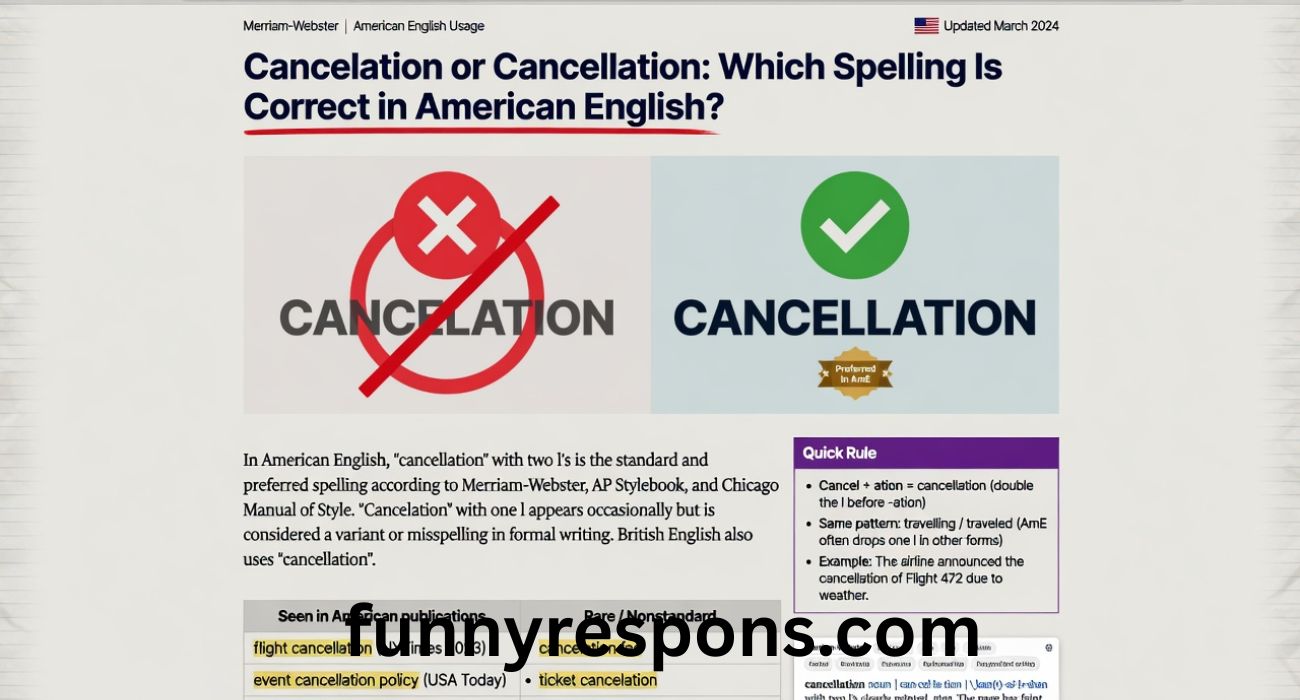
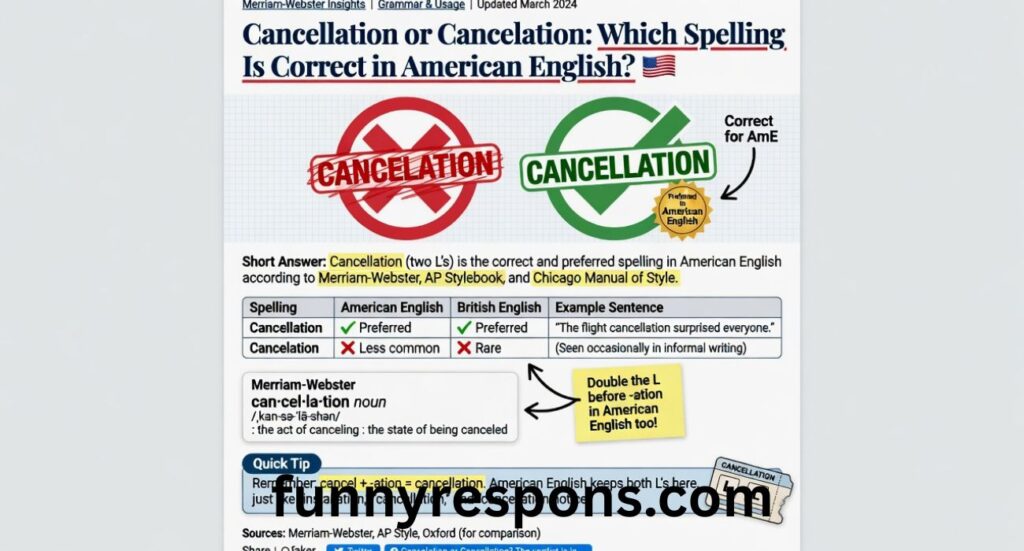
“Cancelation or Cancellation” refers to stopping or ending something. People use this word for meetings, flights, events, and subscriptions. “Cancellation” with two L’s is the correct spelling in American English.
Many writers feel confused when they type “Cancelation or Cancellation” in emails or school work. One small letter creates a big spelling mistake. Correct spelling helps your writing look clear and professional.
The word “cancellation” appears in business documents, websites, and newspapers every day. Dictionaries and style guides support this spelling strongly. Learning the correct form improves grammar, confidence, and writing skills.
| Spelling | Status in American English | Common Usage |
| Cancellation | Standard and preferred | Professional and formal writing |
| Cancelation | Rare alternative variant | Informal or outdated usage |
What Is the Difference Between “Cancelation” and “Cancellation”?
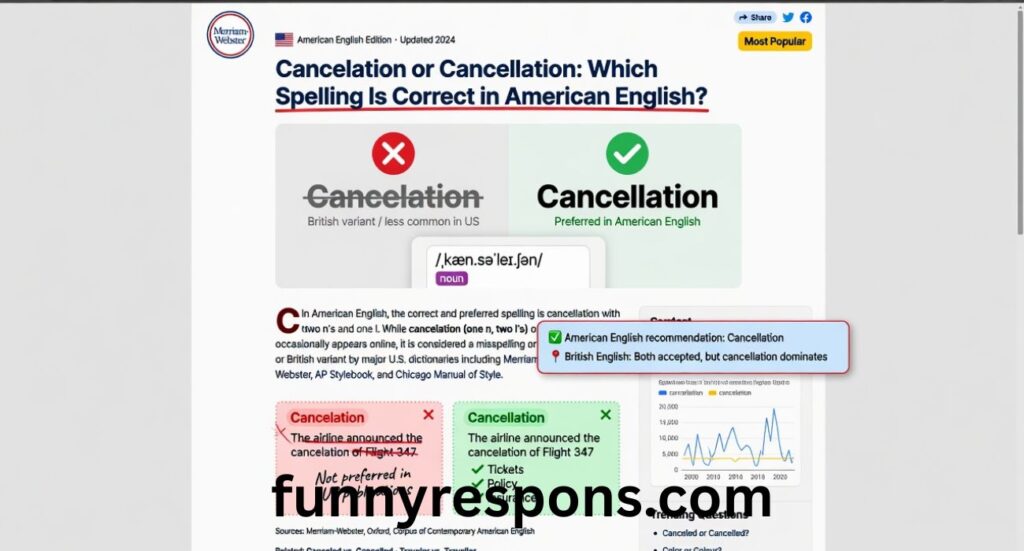
At first glance, the difference looks tiny. One version uses a single “L” while the other doubles it. Yet that extra letter changes how readers judge your writing. The standard form in modern English is “cancellation” with two L’s. This spelling appears in legal papers, business communication, and academic writing because it follows accepted “cancellation spelling rules” and standard English vocabulary patterns. Writers who want polished content usually avoid “cancelation.”
Language experts explain that the double L developed naturally through English suffix rules. When writers add “-ation” to “cancel,” the consonant doubles in the noun form. That pattern also appears in other English words. This is why teachers discuss topics like “double L in cancellation,” “cancellation examples,” “cancellation pronunciation,” and “cancellation usage” when teaching grammar. Although both spellings may appear online, “cancellation” remains the safer and smarter option in formal communication.
Read Also : Funny Ways to Say Goodnight Over Text: Creative Messages That Make Nights More Fun
Common Mistakes When Using “Cancellation” and How to Avoid Them
One common mistake happens when people type quickly and remove one “L” without noticing. Spell-check tools sometimes fail to flag the issue because some dictionaries still recognize “cancelation” as a variant. That creates confusion around “cancellation grammar,” “cancellation in professional writing,” and “cancellation in business communication.” Many students and professionals accidentally repeat this spelling error in emails, presentations, and reports.
Another mistake involves mixing British and American spelling patterns in the same document. Writers may use “canceling” with one L but suddenly switch to “cancellation” with two L’s. That inconsistency weakens writing clarity. To avoid these problems, proofreading matters. Reading text aloud often reveals awkward spelling patterns. Strong editing habits improve “cancellation style guides,” “cancellation standard spelling,” and overall writing accuracy in formal English communication.
Quick Examples of Correct and Incorrect Usage
Correct usage sounds natural and polished. For example, “The cancellation of the concert disappointed thousands of fans” follows standard English rules. Incorrect usage appears less professional, especially in business communication. A sentence like “The cancelation of the meeting upset employees” may distract readers because the spelling looks unfamiliar.
Grammar experts often remind writers that consistency matters more than complexity. Clear spelling improves trust. That is why publishers, editors, and teachers focus heavily on “cancellation in dictionaries,” “cancellation in media writing,” and “cancellation in formal writing.” Even small spelling choices shape how readers judge your expertise and professionalism.
How to Spell Related Words: Cancel, Canceling, Cancellation Explained
English spelling becomes tricky because related words follow different regional patterns. In American English, writers usually prefer “canceling” with one L. British English often uses “cancelling” with two L’s. However, the noun “cancellation” almost always keeps the double L regardless of region. These patterns explain why people search for “cancellation word origin,” “cancellation language rules,” and “cancellation writing tips.”
This spelling difference connects directly to broader grammar rules involving suffixes and consonants. The confusion between “cancellation vs cancelling,” “canceling vs cancelling,” and “cancel spelling differences” reflects larger differences between British and American spelling systems. Writers who understand these patterns usually make fewer grammar mistakes and develop stronger editing habits in professional writing.
| Word | American English | British English |
| Canceling | Preferred | Less common |
| Cancelling | Rare | Preferred |
| Cancellation | Preferred | Preferred |
Which Countries Prefer “Cancellation” Over “Cancelation”?
The United States strongly favors “cancellation” in newspapers, schools, businesses, and official documents. Canada, Australia, New Zealand, and the United Kingdom also prefer this spelling. That worldwide consistency strengthens the authority of “cancellation” as the accepted standard. Because of this global preference, many writers study “American vs British spelling,” “English spelling rules,” and regional spelling differences to improve communication.
Although “cancelation” sometimes appears in older American texts, modern publishers rarely use it. Universities, businesses, and government institutions prefer spelling consistency because it improves readability and professionalism. Readers naturally trust familiar spelling patterns. That trust explains why “cancellation” dominates dictionaries, websites, contracts, and media headlines around the world.
The Impact of Spelling Differences on Professional Writing
Professional writing depends on accuracy. Small mistakes can weaken authority faster than many people realize. A client reading “cancelation” in an important contract might question the writer’s attention to detail. This issue directly affects “grammar spelling tips,” “formal English writing,” and “spelling mistakes in English.” In competitive industries, polished writing often creates stronger first impressions than flashy language.
Businesses spend huge amounts of money building trust with customers. Because of that, companies follow strict editorial standards. Correct spelling improves clarity in emails, advertisements, reports, and website content. Topics like “professional grammar usage,” “common English spelling errors,” and “business writing grammar” matter because clear communication shapes customer confidence and brand reputation.
Quick Tips to Remember the Correct Spelling Every Time
A simple memory trick helps many writers remember the correct spelling. Think of the word as “cancel + lation.” That visual split makes the double L easier to spot. Another useful method involves reading the word slowly: can-cell-ation. These small habits improve proofreading accuracy and reduce spelling confusion in daily writing tasks.
Writers also benefit from using trusted dictionaries instead of relying only on spell-check software. Modern editing tools help but they are not perfect. Learning core spelling rules improves long-term writing confidence. Students, bloggers, marketers, and office workers all benefit from understanding consistent English spelling patterns and grammar structure.
How Spell Checkers Handle “Cancellation” vs “Cancelation”
Spell-check systems sometimes create more confusion than clarity. Some programs accept “cancelation” because older dictionaries still list it as an alternative variant. That explains many “spell checker spelling issues” faced by writers today. Programs like Microsoft Word and Google Docs may behave differently depending on language settings and regional preferences.
Professional editors rarely trust automated tools completely. Instead, they compare spelling against respected references like AP Stylebook or Merriam-Webster. This careful editing process strengthens “AP style spelling,” “Chicago Manual of Style spelling,” “Oxford dictionary spelling,” and “Merriam-Webster cancellation” standards in professional publishing. Human proofreading still matters more than software suggestions.
Pronunciation Guide: Does Spelling Affect How You Say It?
Interestingly, both spellings sound exactly the same when spoken aloud. The pronunciation remains “can-suh-LAY-shun.” That similarity causes much of the confusion because readers cannot hear the double L. Topics like “editorial spelling standards,” “grammar experts on cancellation,” and “regional spelling variations” become important because pronunciation alone cannot guide correct spelling choices.
English contains many words where pronunciation and spelling do not perfectly match. That strange relationship forms part of normal English language usage. Learning pronunciation separately from spelling helps writers understand why certain words look unusual while still sounding familiar in everyday conversation.
Is “Cancelation” Ever Considered Correct? Grammar Experts Weigh In
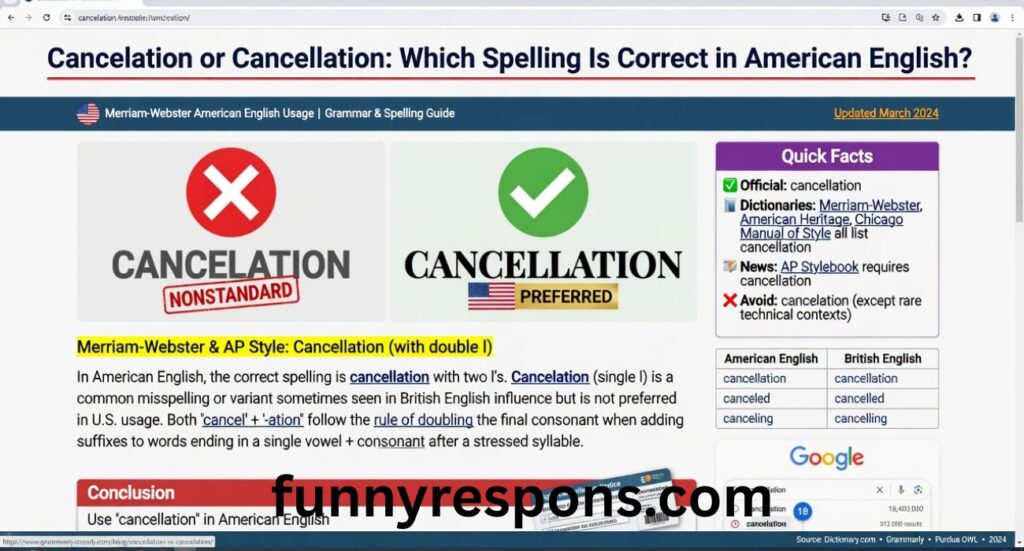
Some dictionaries technically recognize “cancelation” as a variant spelling. However, grammar experts strongly prefer “cancellation” in modern writing. This distinction matters because “recognized” does not always mean “recommended.” Writers searching for the “correct noun spelling” should choose “cancellation” for formal communication, professional documents, and academic work.
Major style guides agree on this recommendation. Publishing companies, universities, and media organizations rarely accept “cancelation” in edited material. This preference reflects broader “English suffix rules,” “spelling consistency,” and writing clarity standards. In practice, “cancellation” remains the dominant and trusted spelling across modern American English.
How to Use “Cancellation” and “Cancelation” in Business Communication
Business communication values precision above almost everything else. Whether writing refund policies or customer support emails, companies prefer clear language with standardized spelling. Correct grammar creates stronger customer trust. That explains why brands focus heavily on “professional communication spelling,” “academic writing grammar,” and polished messaging in formal documents.
Imagine receiving an airline email that contains obvious spelling mistakes. Confidence immediately drops. Readers often connect writing quality with business reliability. For that reason, companies consistently use “cancellation” in contracts, service agreements, and official notices. Proper spelling supports professionalism and prevents misunderstandings in customer communication.
The Evolution of the Word: From Latin Roots to Modern Usage
The word “cancel” traces back to the Latin word “cancellare,” which meant “to cross out.” Over centuries, English transformed the term into modern forms like “cancel,” “canceling,” and “cancellation.” This fascinating history explains why people study “pronunciation of cancellation,” “cancel culture meaning,” and the broader “language evolution” of English vocabulary.
Historical documents sometimes used several spelling versions before dictionaries standardized English. During earlier centuries, spelling rules changed constantly between regions and publishers. Eventually, “cancellation” became dominant because major dictionaries, schools, and publishers consistently supported it. Modern English now treats it as the preferred spelling almost everywhere.
How Media Style Guides Treat “Cancellation” vs “Cancelation”
Media organizations rely on strict style guides to maintain consistency across articles and broadcasts. Journalists follow trusted references like AP Stylebook and Chicago Manual of Style because standardized spelling improves readability. These guides strongly favor “cancellation” over “cancelation” in headlines, articles, and official reports.
Publishing standards influence public language habits more than many people realize. Readers repeatedly see “cancellation” in newspapers, websites, and magazines, which reinforces the spelling as normal and trustworthy. This process shapes modern writing trends and strengthens professional grammar standards across industries and educational systems.
“Cancel Culture” vs “Cancellation”: Are They Related?
Although the words share the same root, their meanings differ completely. “Cancellation” refers to ending or stopping something like a reservation or subscription. “Cancel culture,” however, describes social criticism or public backlash against public figures. Understanding this distinction helps avoid confusion in modern discussions and online conversations.
The phrase “cancel culture” became popular through social media and internet debates. Meanwhile, “cancellation” remained tied to grammar, spelling, and formal communication. Despite sounding similar, these terms belong to different contexts. One belongs to language structure while the other reflects cultural and social behavior.
What Do News Outlets and Publishers Prefer? A Closer Look
Major American news organizations almost always choose “cancellation.” Newspapers and broadcasters follow editorial guidelines closely because consistency improves credibility. Readers expect polished language from respected publishers. That expectation explains why trusted media outlets avoid uncommon spellings that may distract audiences.
Search through headlines from major publishers and a clear pattern appears immediately. “Cancellation” dominates news reports involving airlines, concerts, contracts, subscriptions, and political events. This consistency reinforces public trust and shapes modern spelling habits across online and print media.
Cultural Preferences: How Spelling Reflects Regional Identity
Language often reflects cultural identity as much as grammar rules. American English and British English developed different spelling traditions over time. Yet both regions still strongly support “cancellation” in formal writing. This shared preference shows how certain spellings become globally accepted despite regional differences elsewhere.
Regional habits still affect related words like “canceling” and “cancelling.” Those variations reveal how English evolves differently across countries. Still, “cancellation” remains remarkably stable worldwide. Schools, publishers, and businesses continue teaching and using it as the trusted standard spelling.
Editorial Standards: Which Spelling Do Major Brands Use?
Large companies maintain detailed editorial guidelines because consistency shapes customer experience. Brands like Apple, Netflix, and Amazon almost always use “cancellation” in policies and support documents. That consistency improves readability and prevents confusion during customer interactions involving subscriptions or service changes.
Strong editorial standards also protect brand image. Companies avoid uncommon spelling variants because readers may interpret them as careless mistakes. Modern businesses understand that grammar accuracy influences trust. Even one unusual spelling choice can affect how customers view professionalism and reliability.
Why “Cancellation” Dominates Search Engines and Online Writing
Search engines favor consistency because users trust familiar spelling patterns. That is one reason “cancellation” appears far more often than “cancelation” across websites, blogs, and news articles. Google’s search results strongly support the standard version, which helps improve writing credibility and search visibility for businesses, bloggers, and content creators targeting American readers online.
Content writers who use the accepted spelling often perform better in SEO rankings because readers naturally search for familiar terms. Strong keyword usage connected to “cancellation spelling,” “correct spelling of cancellation,” and “cancellation standard spelling” helps articles appear more trustworthy. Clear language also lowers bounce rates because visitors feel comfortable reading polished and professional content.
Why Schools Teach “Cancellation” Instead of “Cancelation”
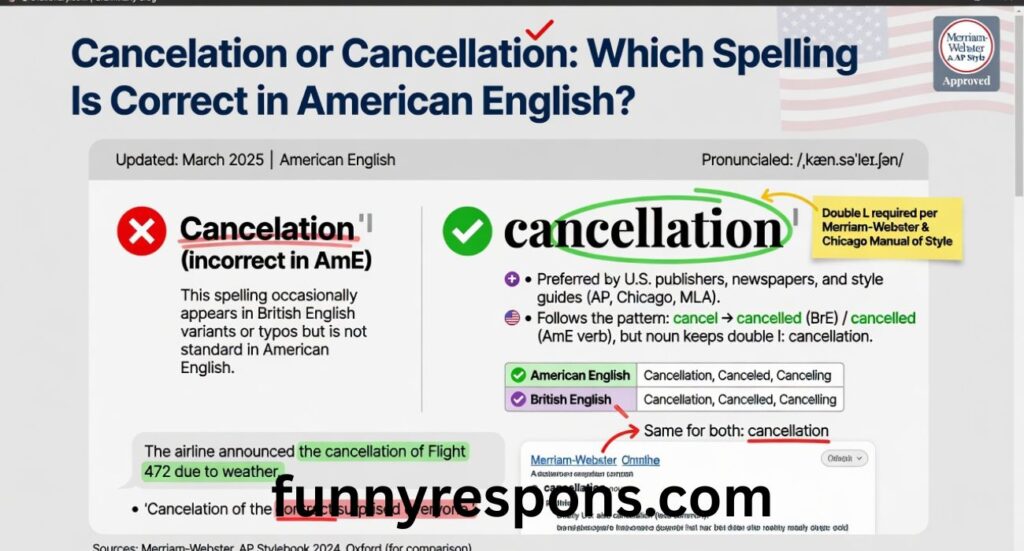
Schools focus on teaching spelling patterns that students will use throughout life. Teachers prefer “cancellation” because dictionaries, textbooks, and academic style guides consistently support that version. Students who learn the standard spelling early develop stronger grammar habits and avoid confusion later in college essays, job applications, and professional communication tasks.
Educational systems also emphasize consistency because repeated spelling mistakes weaken writing clarity. Topics like “cancellation grammar,” “English spelling rules,” and “grammar spelling tips” appear frequently in classrooms for that reason. Learning proper spelling early helps students build confidence and improve their overall understanding of formal English writing and communication standards.
Why “Cancellation” Looks More Natural to Native English Speakers
Native English speakers grow up seeing “cancellation” in newspapers, websites, and business documents almost every day. Familiarity shapes reading comfort. When readers notice “cancelation,” the missing letter often feels visually strange even if they cannot immediately explain why. That reaction happens because repeated exposure trains the brain to recognize common spelling structures automatically.
Language experts explain that readers process familiar spellings faster than uncommon ones. This affects readability and engagement in articles, advertisements, and social media posts. Strong spelling consistency supports smoother reading experiences and improves writing flow. That is why professional editors carefully follow trusted dictionary standards and established publishing style rules.
Why Businesses Avoid Rare Spelling Variants in Marketing
Marketing depends heavily on trust and first impressions. Businesses avoid unusual spellings because even tiny grammar issues can make brands appear careless or unprofessional. Using “cancellation” instead of “cancelation” helps companies maintain credibility in customer emails, service policies, refund notices, and website communication where accuracy matters most.
Brand consistency also influences customer confidence during important decisions. Readers expect polished writing from reliable companies. Because of that expectation, businesses follow strict editorial systems connected to “professional communication spelling,” “business writing grammar,” and “cancellation in professional writing.” Consistent spelling protects brand identity while improving readability and customer understanding across digital platforms.
How Social Media Increased Confusion Around “Cancelation”
Social media spreads language trends quickly, including spelling mistakes and informal writing habits. Users often type rapidly without proofreading, which increases confusion around “cancelation” and “cancellation.” Viral posts, comments, and captions sometimes repeat incorrect spellings so frequently that readers begin questioning which version actually follows accepted English grammar rules.
Online communication also favors speed over precision. That relaxed style allows unusual spellings to circulate widely across platforms like X, Facebook, and TikTok. Despite this trend, publishers and grammar experts still recommend “cancellation” for professional communication. Formal writing standards continue to matter strongly in business, education, and media environments today.
Why Dictionaries Still Mention “Cancelation”
Some modern dictionaries still list “cancelation” because language history matters in lexicography. Earlier English texts occasionally used the single-L spelling before “cancellation” became dominant. Dictionaries document language usage rather than simply declaring rules, which explains why rare variants sometimes remain included alongside more common spellings and accepted grammar standards.
However, dictionary inclusion does not automatically mean equal acceptance. Most trusted references clearly label “cancellation” as the preferred version in modern American English. Publishers, universities, and businesses overwhelmingly support the double-L spelling because it improves consistency, professionalism, and reader trust across formal communication and public-facing written content today.
How Proofreading Helps Prevent Spelling Errors in Formal Writing
Proofreading catches mistakes that spell-check software often misses. Writers frequently overlook small issues like missing letters because the brain automatically fills gaps while reading familiar words. Slowing down during editing helps identify spelling problems connected to “proofreading spelling errors,” “writing clarity,” and “cancellation writing accuracy.”
Professional editors recommend reading content aloud because spoken rhythm often reveals hidden grammar mistakes. Another useful technique involves reviewing text after taking a short break. Fresh eyes notice errors more easily. Careful proofreading improves professionalism and helps writers maintain stronger communication standards in academic, corporate, and online publishing environments every day.
Why “Cancellation” Matters in Legal and Contract Writing
Legal writing depends on precision because even tiny wording mistakes may create confusion or disputes. Contracts, policies, and agreements usually contain terms related to reservations, subscriptions, or service endings. Because of that, lawyers and legal editors strongly prefer “cancellation” to maintain consistency and avoid misunderstandings in official documentation and client communication.
Courts and legal systems value standardized language because consistency improves interpretation. A familiar spelling reduces ambiguity and strengthens document reliability. This explains why industries connected to insurance, travel, banking, and healthcare consistently use “cancellation” in customer agreements, service terms, and formal notices involving rights, obligations, or policy changes.
Why Readers Trust Correct Spelling More Than Fancy Vocabulary
Readers often notice spelling mistakes before they appreciate advanced vocabulary. Clean grammar creates trust quickly while unusual errors can distract from valuable information. Using “cancellation” correctly signals professionalism and attention to detail. That small choice improves readability and helps audiences focus on the message instead of questioning the writer’s language skills.
Simple language usually performs better than overly complex wording because readers prefer clarity over confusion. Strong writing combines easy vocabulary with proper grammar and natural flow. Professional communicators understand that accurate spelling, polished structure, and conversational tone build stronger audience engagement than complicated language filled with unnecessary technical expressions.
How English Spelling Continues to Evolve Over Time
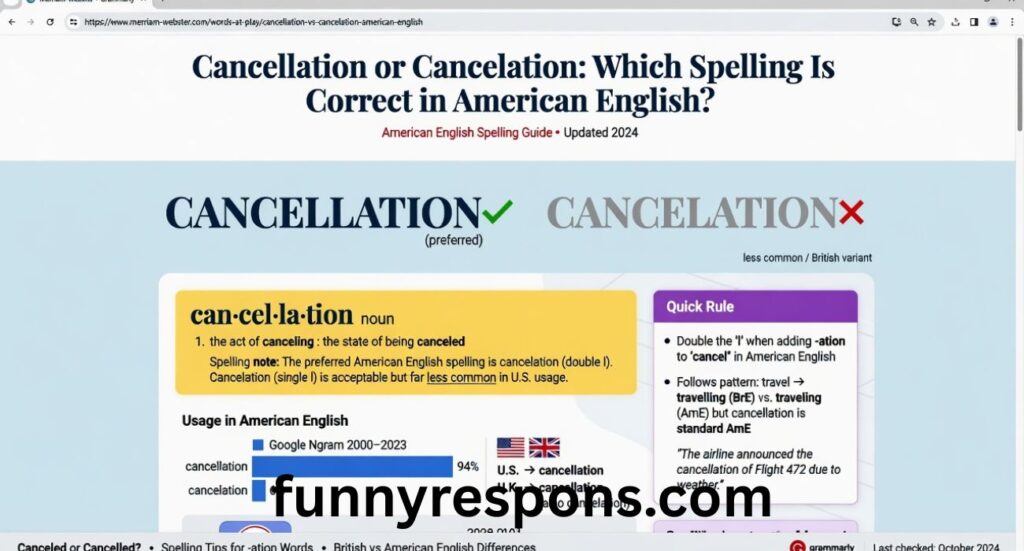
English constantly changes through culture, technology, and global communication. New words appear every year while older spellings sometimes disappear completely. The evolution from “cancelation” toward “cancellation” reflects how dictionaries, publishers, schools, and readers gradually shape accepted language standards through repeated everyday use and widespread public exposure.
Language evolution rarely happens overnight. Instead, spelling preferences develop slowly across generations until one form becomes dominant. Today, “cancellation” clearly leads in business, education, journalism, and digital publishing. That dominance shows how modern English values consistency, readability, and trusted grammar standards in both formal and casual communication worldwide.
FAQs
Is “cancelation” considered wrong in American English?
“Cancelation” is not completely wrong, but it is very rare. Most dictionaries, publishers, and grammar experts prefer “cancellation” with two L’s in modern American English.
Why does “cancellation” have two L’s?
The word follows common English spelling rules where the consonant doubles before adding “-ation.” That is why “cancellation” keeps the double L in formal writing.
Which spelling should businesses use: “cancelation” or “cancellation”?
Businesses should always use “cancellation” because it looks more professional and matches standard English usage in contracts, emails, and customer communication.
Do spell checkers always catch “cancelation” as an error?
Not always. Some spell checkers accept “cancelation” as a variant spelling, which is why proofreading and trusted dictionaries still matter for accurate writing.
Conclusion
Many people feel confused about “Cancelation or Cancellation” because both spellings appear online. However, “cancellation” with two L’s remains the correct and trusted spelling in American English. Schools, businesses, newspapers, and dictionaries all use this form in daily writing. Correct spelling improves grammar, writing clarity, and professional communication. It also helps readers understand your message quickly and clearly.
Learning the difference between “Cancelation or Cancellation” helps students and writers avoid common spelling mistakes. Good spelling builds confidence in emails, essays, reports, and formal documents. Simple grammar habits create stronger writing skills over time. When you use “cancellation” correctly, your writing looks polished, clear, and professional. Small spelling improvements often make a big difference in English communication.