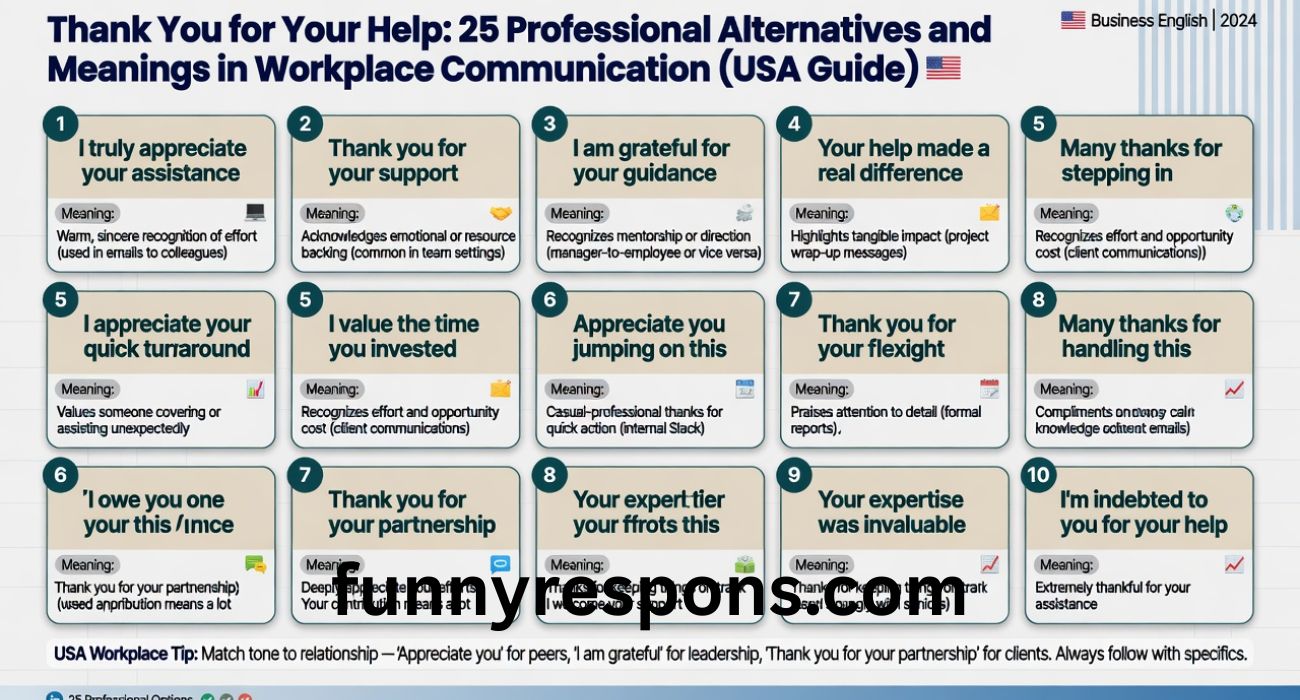
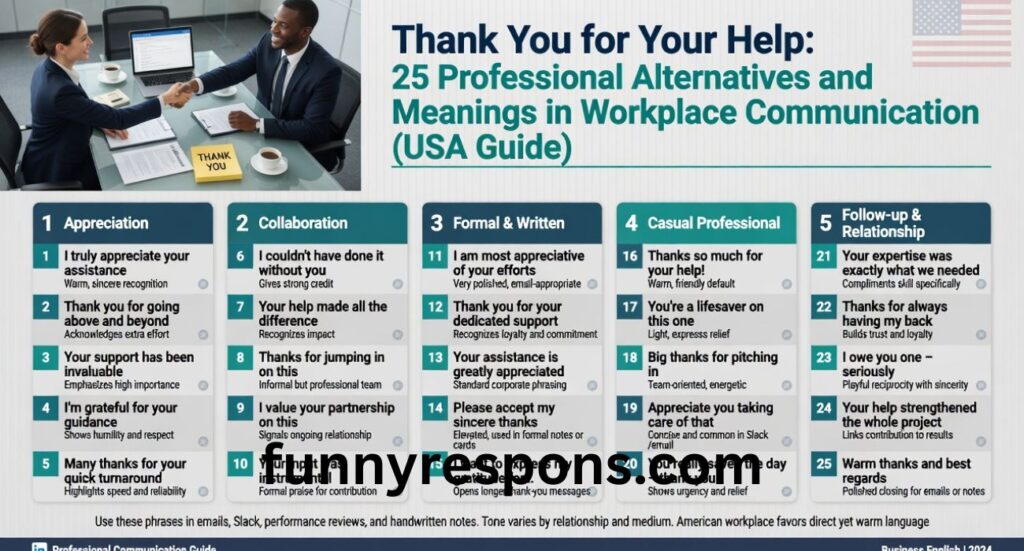
Thank You for Your Help: 35 Professional Alternatives and Meanings in Workplace Communication (USA Guide)
“Thank you for your help” is a simple expression of gratitude. It means you feel grateful when someone supports you. People use it in work, school, and daily life communication.
Many people use this phrase in emails and messages every day. It helps create a polite and respectful tone quickly. Small and simple words often leave a strong and positive impact.
This phrase is widely used in professional communication. It shows appreciation for effort and support from others. Clear and polite words help build better relationships and trust.
Thank You for Your Help in Professional Communication
Using thank you for your help in workplace communication may look simple, but it strongly shapes tone. In American offices, polite wording reflects respect, teamwork, and emotional intelligence in emails, chats, and daily client updates across professional environments.
However, repeating thank you for your help reduces impact over time. Professionals use formal thank you alternatives and business appreciation expressions to sound natural, clear, and engaging. Strong gratitude improves trust, cooperation, and workplace communication politeness in all business interactions.
Read Also : Requester vs Requestor: Meaning, Grammar, Spelling, and Correct Usage Explained
1. Thank you for your support with this issue
This phrase works when someone helps solve a problem quickly. It shows thank you for your support with this issue in a calm and respectful tone during stressful workplace situations.
It fits email updates after problems are fixed. Using it shows timely support and helps keep communication smooth, especially when quick action is needed in professional environments.
It also reflects sincere appreciation without sounding too formal. You can use it in daily communication when you want clarity and simple gratitude toward colleagues or clients.
2. I appreciate your help on this
This phrase is short and natural for daily use. I appreciate your help on this works well in both casual workplace chats and professional email exchanges.
It avoids complexity while still showing respect. Many professionals use it because it fits professional email gratitude phrases without sounding overly formal or robotic.
It also builds friendly tone quickly. You can use it after tasks, meetings, or shared work where simple acknowledgment is enough to maintain good communication flow.
3. Grateful for your cooperation
This phrase is useful in teamwork situations. Grateful for your cooperation highlights shared effort and works well in group projects or coordinated business tasks.
It supports teamwork acknowledgment phrases by showing mutual responsibility. It feels balanced and respectful in both internal and external communication environments.
It also strengthens corporate gratitude language. You can use it when multiple people contribute to a process and coordination plays a key role in success.
4. Thanks for your guidance regarding this
This phrase fits situations where advice matters more than action. Thanks for your guidance regarding this shows respect for expertise and decision-making support.
It is commonly used in mentorship or leadership communication. It reflects professional appreciation variations when someone helps you avoid mistakes or improve direction.
It also strengthens learning tone. You can use it when feedback or advice directly influences your decisions or project outcomes in workplace settings.
5. Many thanks for your attention to this matter
This phrase works well in formal communication. Many thanks for your attention to this matter is often used in business emails and official updates.
It reflects seriousness and respect in tone. It is common in client email wording where clarity and professionalism are required.
It also signals responsiveness. You can use it when someone carefully reviews or handles an important request in structured communication.
6. I sincerely appreciate your input
This phrase values ideas and suggestions. I sincerely appreciate your input is useful in meetings, discussions, or collaborative decision-making environments.
It highlights appreciation of input rather than action alone. This makes it ideal for brainstorming or planning situations.
It also supports constructive feedback culture. You can use it when someone’s opinion helps improve outcomes or guides better decisions.
7. Thanks for your valuable assistance
This phrase emphasizes importance of help. Thanks for your valuable assistance is often used in client communication or professional problem-solving situations.
It reflects valuable assistance in a clear and respectful way. It works well when tasks require effort and responsibility.
It also strengthens business tone. You can use it when someone’s help directly impacts results or prevents delays in workflow.
8. I’m thankful for your aid in this
This phrase is slightly formal but clear. I’m thankful for your aid in this fits structured communication like reports or official emails.
It reflects formal correspondence gratitude phrases in professional environments. It shows respect while maintaining distance in tone.
It also works in documentation settings. You can use it when describing support in official updates or written summaries.
9. Appreciating your efforts in resolving this
This phrase highlights action and results. Appreciating your efforts in resolving this is useful when someone actively fixes a problem.
It shows efforts in resolving this clearly and directly. It is common in technical or operational communication.
It also reinforces accountability. You can use it when acknowledging real problem-solving work that improves outcomes.
10. Thank you for your prompt help
This phrase highlights speed. Thank you for your prompt help is used when fast response prevents delays or issues.
It reflects prompt help in urgent communication. It is common in workplace situations where timing matters.
It also improves tone efficiency. You can use it when someone responds quickly and helps avoid disruption in workflow.
11. Thanks for your collaboration on this
This phrase focuses on teamwork. Thanks for your collaboration on this is widely used in project-based communication.
It reflects collaboration on this between multiple contributors. It supports shared responsibility in professional environments.
It also improves group communication. You can use it when teams work together toward a shared goal or deadline.
12. I appreciate your dedication to this matter
This phrase shows strong effort. I appreciate your dedication to this matter is used in long-term or complex tasks.
It reflects dedication to this matter in a respectful tone. It is common in leadership communication.
It also builds recognition. You can use it when someone consistently supports a project or responsibility.
13. Grateful for your involvement
This phrase highlights participation. Grateful for your involvement works in group discussions or project planning stages.
It reflects involvement as active contribution. It feels inclusive and respectful in tone.
It also encourages engagement. You can use it when someone plays a meaningful role in shared work.
14. Thank you for your timely support
This phrase emphasizes timing. Thank you for your timely support is used when help arrives at the right moment.
It reflects timely support in professional settings. It is useful in urgent or deadline-driven situations.
It also strengthens reliability. You can use it when quick action improves results or prevents delays.
15. Many thanks for your expert help
This phrase values skill. Many thanks for your expert help is used when specialized knowledge is involved.
It reflects expert help in technical or professional environments. It shows respect for ability.
It also builds credibility. You can use it when someone solves complex or specialized problems.
16. I appreciate your kind assistance
This phrase adds warmth. I appreciate your kind assistance works well in polite and respectful communication.
It reflects kind assistance in a human tone. It is suitable for both formal and semi-formal settings.
It also improves emotional tone. You can use it when someone helps patiently or thoughtfully.
17. Thanks for your continued support
This phrase focuses on long-term relationships. Thanks for your continued support is common in business partnerships.
It reflects continued support over time. It builds trust in professional communication.
It also strengthens loyalty. You can use it when maintaining ongoing collaboration or service relationships.
18. Thank you for lending a hand with this
This phrase is casual and friendly. Thank you for lending a hand with this works in informal workplace communication.
It reflects lending a hand in simple language. It is useful for quick teamwork tasks.
It also keeps tone light. You can use it when someone helps briefly or informally.
19. I’m grateful for your attentive help
This phrase highlights focus. I’m grateful for your attentive help is used when detail matters.
It reflects careful attentive help in professional settings. It is useful in review or precision tasks.
It also improves recognition. You can use it when accuracy and focus improve results.
20. Thanks for your constructive feedback
This phrase supports improvement. Thanks for your constructive feedback is used in review and evaluation processes.
It reflects constructive feedback in a positive way. It encourages growth and learning.
It also improves communication quality. You can use it when feedback helps refine work.
21. I appreciate your readiness to assist
This phrase values willingness. I appreciate your readiness to assist highlights reliability and support mindset.
It reflects readiness to assist before action is even taken. It shows trust.
It also builds teamwork strength. You can use it when someone is always available to help.
22. Thank you for your thorough support
This phrase highlights completeness. Thank you for your thorough support is used in detailed tasks.
It reflects thorough support in structured work. It ensures nothing is missed.
It also improves clarity. You can use it when tasks require full attention and accuracy.
23. Many thanks for your cooperation
This phrase is formal and polite. Many thanks for your cooperation is widely used in business communication.
It reflects cooperation in structured environments. It supports smooth coordination.
It also maintains professionalism. You can use it in official emails or updates.
24. I appreciate your commitment to this matter
This phrase shows responsibility. I appreciate your commitment to this matter highlights long-term dedication.
It reflects commitment to this matter in professional tone. It is often used in leadership contexts.
It also builds respect. You can use it when someone consistently stays engaged in work.
25. Thanks for your valuable contribution
This phrase highlights impact. Thanks for your valuable contribution is used in teamwork and project success.
It reflects valuable contribution clearly. It recognizes meaningful input.
It also strengthens collaboration. You can use it when someone improves outcomes significantly.
26. I appreciate your quick response to this matter
This phrase works when speed matters in communication. I appreciate your quick response to this matter shows that someone acted without delay and helped move things forward smoothly.
It reflects prompt help in a professional setting. It is commonly used in emails when timing is critical and fast action prevents problems from growing.
It also strengthens workplace trust. You can use it when a colleague or client replies quickly and keeps the workflow on track.
27. Thanks for your help in resolving this matter efficiently
This phrase highlights both action and results. Thanks for your help in resolving this matter efficiently shows that the issue was handled with skill and speed.
It reflects efforts in resolving this in a structured and professional way. It is often used after problem-solving situations in business communication.
It also improves tone clarity. You can use it when someone fixes an issue with minimal delay and maximum effectiveness.
28. I truly appreciate your ongoing support
This phrase focuses on consistency over time. I truly appreciate your ongoing support is ideal for long-term business relationships and partnerships.
It reflects continued support in a natural and respectful tone. It helps strengthen professional trust and reliability.
It also builds relationship depth. You can use it when someone consistently assists you across multiple tasks or projects.
29. Thank you for your professionalism and support
This phrase highlights both attitude and action. Thank you for your professionalism and support is common in formal workplace communication.
It reflects corporate gratitude language in a respectful and polished way. It is often used in client-facing emails.
It also reinforces credibility. You can use it when someone handles tasks with care, respect, and strong communication skills.
30. I appreciate your willingness to go the extra mile
This phrase values effort beyond expectations. I appreciate your willingness to go the extra mile shows deep recognition of dedication.
It reflects valuable contribution in a more expressive tone. It is often used when someone exceeds normal responsibilities.
It also builds motivation. You can use it when a colleague or partner puts in extra effort to ensure success.
31. Thanks for your reliable support on this matter
This phrase highlights consistency and trust. Thanks for your reliable support on this matter shows that someone can be depended on.
It reflects thorough support in ongoing communication. It is useful in professional environments where dependability matters.
It also strengthens confidence. You can use it when someone repeatedly delivers quality help.
32. I’m grateful for your clear communication and assistance
This phrase values clarity. I’m grateful for your clear communication and assistance is useful when explanations help avoid confusion.
It reflects constructive feedback and smooth understanding in workplace interaction. It improves collaboration quality.
It also enhances efficiency. You can use it when someone explains things in a simple and helpful way.
33. Thank you for stepping in and helping with this
This phrase is useful in urgent situations. Thank you for stepping in and helping with this shows immediate action and responsibility.
It reflects lending a hand during unexpected challenges. It is common in team environments.
It also shows appreciation for initiative. You can use it when someone voluntarily helps during a critical moment.
34. I appreciate your patience and support
This phrase focuses on calm assistance. I appreciate your patience and support is useful when dealing with delays or complex issues.
It reflects kind assistance in a respectful and human tone. It helps maintain positive communication even in difficult situations.
It also builds goodwill. You can use it when someone stays helpful during long or slow processes.
35. Thanks for your consistent efforts on this project
This phrase highlights steady work. Thanks for your consistent efforts on this project is ideal for long-term collaboration.
It reflects dedication to this matter over time. It shows appreciation for persistence and focus.
It also strengthens teamwork morale. You can use it when someone stays actively involved from start to finish.
Professional Ways to Say Thank You for Your Help in Business Emails and Workplace Communication
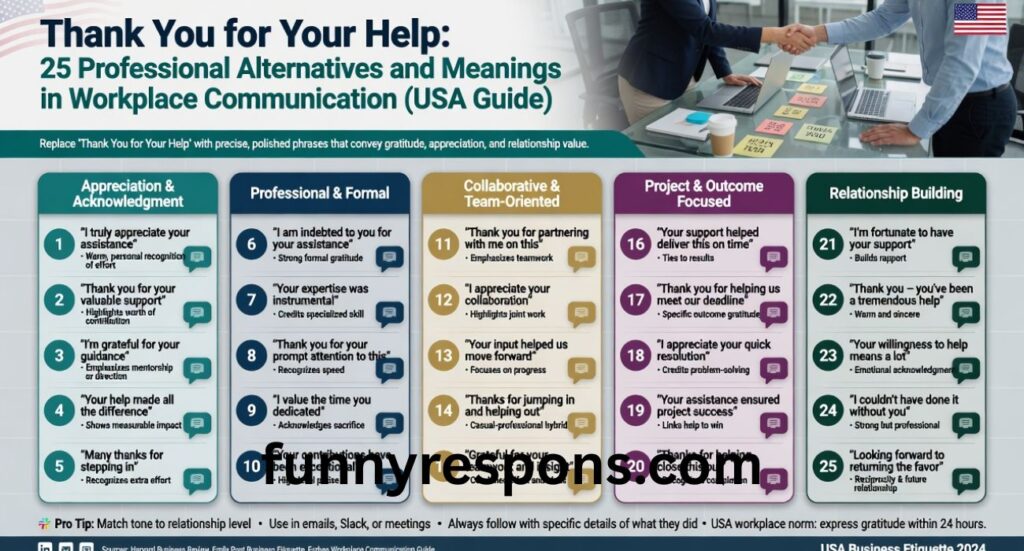
Using better alternatives to thank you for your help can instantly improve how your emails sound in the USA workplace. Strong wording reflects professional email gratitude phrases and shows respect in both internal and client communication. Instead of repeating the same phrase, you can adjust tone based on urgency, relationship, and context for clearer, more human messages.
Good communication depends on balance between clarity and warmth. When you use business appreciation expressions, your message feels intentional rather than automatic. This helps you maintain strong workplace communication politeness while avoiding repetitive language. Over time, these small changes build trust, improve responses, and strengthen your professional image across emails, meetings, and collaborative projects.
Read Also : 40+ Heartfelt Alternatives to “Rest in Peace” With Meaning, Quotes, and Sympathy Messages
Formal Thank You Alternatives That Improve Workplace Email Etiquette
Formal communication often requires more polished expressions than simple gratitude. Phrases like many thanks for your attention to this matter or thank you for your prompt help reflect structured formal thank you alternatives that fit corporate environments. These expressions show professionalism while keeping tone respectful and easy to understand.
Using proper wording also improves email etiquette expressions in high-stakes communication. It helps avoid confusion and adds clarity in client or management emails. When you consistently apply corporate gratitude language, your messages sound more refined, and your communication becomes more effective in professional and business-focused environments.
Business Appreciation Expressions for Team Collaboration and Projects
In team environments, expressing gratitude goes beyond simple thanks. Using phrases like thanks for your collaboration on this or grateful for your involvement reflects strong teamwork acknowledgment phrases. These expressions highlight shared responsibility and encourage a positive work culture where everyone feels valued and recognized.
Collaboration improves when appreciation feels genuine. Applying project collaboration thanks helps teams stay motivated and engaged. It also strengthens relationships between colleagues by showing that effort is noticed. Over time, this approach improves cooperation, boosts productivity, and creates a healthier communication environment within teams and departments.
Client Email Wording That Builds Trust and Professional Relationships
Client communication requires clarity, respect, and consistency. Phrases like I appreciate your kind assistance or thanks for your continued support help maintain strong client email wording and build long-term trust. These expressions show reliability and professionalism in every interaction.
When you use customer service appreciation wording, you create a smoother communication experience. Clients feel valued when their efforts or patience are acknowledged properly. This improves satisfaction and encourages ongoing partnerships. Strong communication also reduces misunderstandings and strengthens business relationships over time.
Constructive Feedback and Appreciation in Professional Communication
Feedback situations require careful wording. Saying thanks for your constructive feedback or I sincerely appreciate your input helps maintain a respectful tone while encouraging improvement. These phrases reflect healthy communication and support growth in both individual and team performance.
Using constructive feedback language ensures criticism feels supportive rather than negative. It also promotes open dialogue where ideas are shared freely. When combined with professional appreciation variations, feedback becomes a tool for development instead of tension, improving workplace collaboration and decision-making quality.
Timely Support and Prompt Help in Fast-Paced Work Environments
In urgent situations, timing matters as much as action. Phrases like thank you for your prompt help or thank you for your timely support highlight responsiveness. These expressions reflect prompt help and show appreciation for quick decision-making in fast-moving workplace environments.
Recognizing speed improves trust and reliability. When you consistently use timely support phrases, colleagues understand that their quick actions matter. This encourages faster communication cycles and better coordination, especially in industries where delays can impact performance or client satisfaction.
Expert Help and Technical Assistance in Professional Settings
Specialized tasks often require deeper appreciation. Using phrases like many thanks for your expert help or thanks for your valuable assistance shows respect for skill and knowledge. These expressions highlight expert help in technical, medical, or professional environments where accuracy is essential.
Acknowledging expertise improves professional relationships. It also reinforces confidence in team capabilities. When you use valuable assistance language, you show that complex work is recognized and appreciated. This builds stronger trust between colleagues, clients, and service providers in specialized industries.
Kind Assistance and Attentive Help in Workplace Communication
Polite communication often depends on tone. Saying I appreciate your kind assistance or I’m grateful for your attentive help adds warmth to professional messages. These phrases reflect kind assistance and show attention to both effort and attitude.
Using softer language improves workplace relationships. It makes communication feel more human and less mechanical. When combined with attentive help recognition, it also shows respect for detail-oriented work. This helps maintain positive interactions even during stressful or complex tasks.
Continued Support and Long-Term Professional Relationships
Long-term partnerships require consistent appreciation. Phrases like thanks for your continued support or I appreciate your commitment to this matter reflect ongoing trust. These expressions show stability and reliability in professional communication.
Using continued support language strengthens business relationships over time. It acknowledges that success often depends on repeated collaboration. This type of gratitude builds loyalty, encourages future cooperation, and helps maintain strong professional connections across projects and organizations.
Commitment and Dedication in Workplace Appreciation Messages
Strong effort deserves strong recognition. Saying I appreciate your dedication to this matter or thanks for your valuable contribution highlights commitment and responsibility. These phrases reflect dedication to this matter in a professional and respectful tone.
Acknowledging commitment improves motivation and engagement. It shows that consistent effort is valued, not just final results. When you use valuable contribution expressions, you reinforce a culture of accountability and appreciation in the workplace.
Cooperation and Collaboration in Professional Email Communication
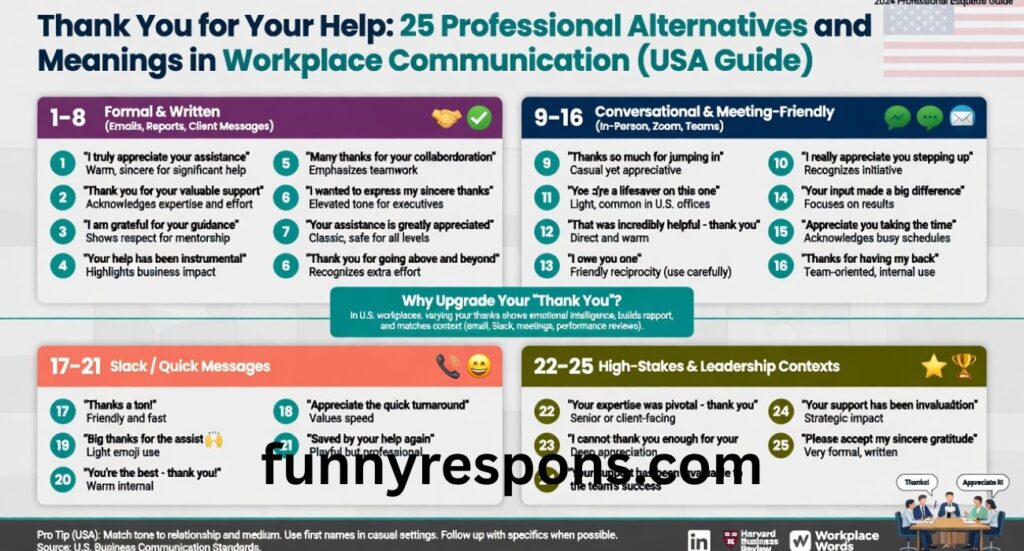
Smooth teamwork depends on cooperation. Phrases like many thanks for your cooperation or grateful for your cooperation show respect for shared effort. These expressions reflect cooperation in structured communication and help maintain professionalism in business interactions.
Using collaboration on this language improves clarity and teamwork efficiency. It shows that success is shared, not individual. This approach strengthens professional relationships, reduces friction, and encourages better coordination across teams and departments.
FAQs
What is another way to say “thank you for your help” in professional emails?
You can say “I appreciate your support with this issue” or “thanks for your valuable assistance”. These sound more polished and fit better in formal workplace communication.
Is “thank you for your help” formal or informal?
It is neutral and works in both settings. However, in formal emails, people often prefer “many thanks for your attention to this matter” or similar professional alternatives.
How do you say thank you for help in a more polite way?
You can use phrases like “I sincerely appreciate your input” or “I’m grateful for your cooperation”. These sound more respectful and professional.
When should I avoid saying “thank you for your help”?
Avoid it in repetitive business emails or formal reports. Instead, switch to varied phrases like “thank you for your prompt help” or “thanks for your continued support.”
Conclusion
The phrase thank you for your help plays an important role in daily workplace communication. It shows respect, kindness, and professionalism in simple words. In emails, meetings, and messages, this phrase helps people express gratitude in a clear and polite way. However, using the same words again and again can sound repetitive, so learning different alternatives makes communication stronger and more natural. These variations help you sound more confident and thoughtful in professional situations.
Using the right words also improves relationships at work and builds trust over time. Simple expressions like thank you for your help or its alternatives can make conversations smoother and more respectful. When you choose your words carefully, you create better understanding and cooperation. Good communication does not need complex language. It only needs clear, simple, and respectful words that show real appreciation for others’ support and effort.